
8 Prompts for Reading That Make Books Stick in 2026
The Quotabl team · · 15 min read
You close the last page of a book that kept you highlighting late into the night. You feel certain the central argument will stick, yet three weeks later you can barely recall a single chapter.
That drop-off hurts even more when reading time is already tight. According to YouGov, 59% of Americans read at least one book in 2025, with the median reader finishing two books and the average at eight. Meanwhile, statistics compiled by Statista show that Americans spent approximately 16 minutes per day reading in 2025. When you only have a quarter of an hour a day, passive rereading wastes the effort you already put in.
Using structured prompts for reading turns passive eye movement into active recall. Instead of handing you a loose pile of abstract questions, the eight methods below are organized by when you use them (during a passage, after a chapter, or after finishing the book) and paired with a concrete saving step. Pick the one that matches where your memory breaks down first.
Table of Contents
- 1. Question the Author (QtA)
- 2. Notice and Note Signposts
- 3. Literature Circles
- 4. Reciprocal Teaching
- 5. Adler's Analytical Reading Questions
- 6. Dialectical Journaling
- 7. Rose, Bud, Thorn Reflection
- 8. Bloom's Taxonomy Question Ladder
- How the eight reading prompts compare at a glance
- Turn One Prompt Into a Weekly Reading Habit
1. Question the Author (QtA)
Use Question the Author (QtA) during a passage whenever an argument feels slippery or too smooth to trust. Instead of treating printed text as settled truth, you pause mid-paragraph and interrogate the writer's choices, intent, and evidence.
The diagram below shows how a single highlighted passage can branch into targeted questions rather than sitting passively on the page.
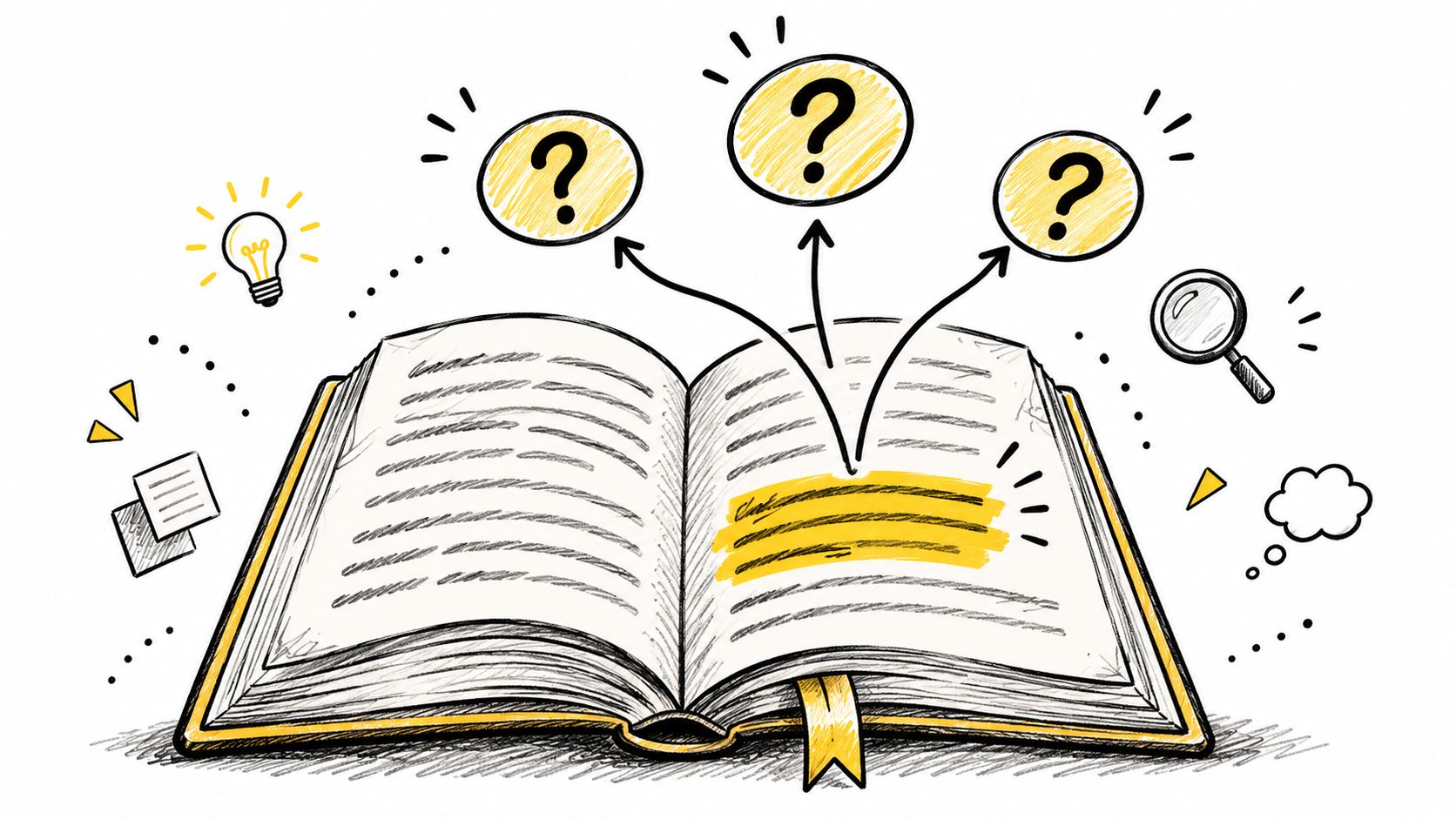
Asking targeted questions while you read does more than check whether you were paying attention. In a 2016 study by Smith, Blunt, Whiffen, and Karpicke at Purdue University reviewed by the U.S. Institute of Education Sciences What Works Clearinghouse, prompted retrieval activities involving 60 undergraduate students produced statistically significant positive effects on reading-comprehension outcomes after a one-week delay. Both free-prompted and prompted-prompted conditions showed statistically significant gains on higher-order questions (35 students in each comparison) and on verbatim questions (29 and 25 students respectively).
Three Questions to Ask While You Read
Pick one dense passage per chapter and write three short prompts before moving on:
- Initial-understanding prompt: Ask what the author is claiming in plain language, stripping away jargon or storytelling flourishes.
- Generative prompt: Ask why the author placed this specific example here and what counterargument they left out.
- Connection prompt: Ask how this passage builds on or contradicts an earlier chapter or another book you've read.
Teachers often run QtA during elementary and middle school read-alouds by stopping mid-scene to ask why a writer phrased a line a certain way, and educators looking for classroom structures can browse adaptable comprehension lesson examples. Adult book clubs use the same move by having every member bring one highlighted paragraph and one question about the author's intent.
The main trade-off is speed. If you question every page, a fast nonfiction book turns into a slog, so limit QtA to turning points or claims you doubt. For your saving step, highlight the exact passage and type your three questions directly into the attached highlight note, then answer them from memory a week later before rereading the quote.
2. Notice and Note Signposts
Say you're halfway through a novel and a cautious, rule-following character suddenly lies to their closest friend. Most readers glide right past the moment to see what happens next, then wonder at the end of the book why the finale felt unearned.
Notice and Note Signposts is a close-reading system you apply during a passage to catch those exact turning points. It tracks six fiction signposts (such as contrasts and contradictions, tough questions a character can't answer, or words that repeat across scenes) and one nonfiction signpost that flags surprising or extreme claims. Each signpost pairs a recognizable textual pattern with a fixed follow-up question, which keeps you from inventing prompts from scratch.
Practical rule: Write the seven signpost names on a small index card and use it as your bookmark. Checking a physical card takes two seconds and keeps your eyes off your phone.
Middle and high school English classes post signpost charts on the wall so students share a common vocabulary during novel discussions. Adult book groups get the same payoff when members tag signposts across shared chapters and compare which moments each person flagged.
Saving Signposts Without Breaking Reading Flow
Notice and Note works best for literary fiction, memoirs, and narrative nonfiction where character choices or repeated motifs carry the meaning. It's far less helpful for technical manuals, reference guides, or books built around step-by-step checklists.
To keep the habit lightweight, don't write full paragraphs while reading. For your saving step, highlight the trigger line and put only the signpost label plus a one-line guess in the attached note (for example, Again and Again: third time the narrator mentions locked doors). Once you finish the book, export your highlights to Markdown by title and search those labels to see the structural spine the author built.
3. Literature Circles
Reading alone has a quiet flaw: you can nod along to a clever paragraph without ever testing whether you could explain it out loud. Literature Circles fixes that blind spot by moving prompts for reading into a structured small group that prepares between chapters and meets on a set schedule.
Rather than showing up to a meeting with a vague "Did everyone like it?" prompt, each member holds a rotating job that targets one slice of the text.

Rotating Roles That Keep Meetings Focused
Rotate these five classic roles each week so no single voice dominates the table:
- Discussion director: Drafts three open-ended questions about the chapter's big dilemmas or weak arguments to steer conversation.
- Passage master: Selects two or three key quotations from the reading and explains why the group needs to examine them line by line.
- Connector: Links ideas or scenes in the assigned chapters to current events, personal decisions, or other books the group knows.
- Illustrator: Sketches a quick timeline, concept map, or diagram that makes a complex plotline or framework visible at a glance.
- Vocabulary enricher: Flags unfamiliar terms, specialized jargon, or loaded words the author uses repeatedly and brings clear definitions.
In school classrooms, students rotate through these jobs across a novel unit and present a combined summary to the class. Adult reading groups can skip the formal worksheets and rotate the passage master role every meeting, a format that pairs well with practical book club ideas for livelier discussions.
The trade-off is coordination. Literature Circles fail when two people skip their prep and turn the meeting back into small talk. For your saving step, have the passage master export the week's selected highlights and notes into a single Markdown file a day before the meeting so the shared document doubles as both the agenda and a permanent archive.
4. Reciprocal Teaching
Finishing a dense chapter gives you a warm sense of progress, even if you couldn't summarize its argument five minutes later. Reciprocal Teaching catches that illusion after a chapter by forcing your brain to shift from passive intake to active comprehension monitoring.
The method rests on four deliberate moves: predicting, questioning, clarifying, and summarizing. That structure aligns closely with guidance from the University of Rochester Learning Center, which recommends turning learning objectives and textbook headings into questions, answering them without looking at the material, and then checking your response against the text.
Four Steps at the End of Every Chapter
Close the book or dim your e-reader screen at the chapter break and run through this quick sequence:
- Predict: State what you expect the next chapter to prove or resolve based on the author's trajectory so far.
- Question: Write one focused test question that you'd ask a colleague to see if they understood the chapter.
- Clarify: Name one concept, citation, or term that still feels fuzzy so you can look it up instead of pretending you understood it.
- Summarize: Condense the chapter's core point into two plain sentences without peeking back at the headings.
Reading specialists originally built Reciprocal Teaching for middle school interventions, where teachers model the four steps out loud before handing control to student groups, and instructors can explore structured frameworks in Kuraplan reading comprehension resources. Solo adult readers can run the exact same loop in three minutes at the end of every nonfiction chapter.
It's overkill for fast-paced thrillers or light weekend fiction, where pausing to clarify and summarize breaks immersion. Save it for textbooks, strategy books, and dense nonfiction you're reading to learn. For your saving step, attach your clarification note and two-sentence summary to the chapter's single most important highlight so your summaries stack into a complete chapter-by-chapter study guide you can self-quiz later.
5. Adler's Analytical Reading Questions
You finish a celebrated history or business book, set it on your shelf, and a friend asks over dinner what it argued. If your mind goes blank beyond the subtitle, you read the words without interrogating the structure.
Adler's Analytical Reading Questions, drawn from Mortimer Adler and Charles Van Doren's How to Read a Book, work best after finishing the book, with one quick check right before chapter one. They move you deliberately from basic comprehension to independent judgment:
- What is the book about as a whole? Name the central theme and explain how the author develops it from start to finish.
- What is being said in detail, and how? Identify the main claims, supporting evidence, and key arguments that carry the thesis.
- Is the book true, in whole or in part? Decide where the author's evidence holds up and where the logic is incomplete, biased, or outdated.
- What of it? Spell out what changes in your thinking, work, or daily habits if the book's claims turn out to be right.
If you can't answer "What of it?" in two plain sentences, you absorbed facts without connecting them to a decision or belief.
University seminars rely on these four questions to anchor philosophy and history discussions, while nonfiction readers often write a single tight paragraph for each prompt the day they finish a science or business title.
Why Independent Answers Should Come Before AI Summaries
When you finish a demanding book, it's tempting to ask an AI tool for a neat recap right away. Skip that shortcut until you write your own draft first. A 2025 study on participatory AI training published in AI & Society via Springer found that annotating texts for later AI use creates its own opportunities for reflection and learning, pointing toward an AI-last workflow where you form an initial interpretation before asking an AI companion to critique or extend it.
The trade-off with Adler's four questions is effort: they're too heavy for casual entertainment and demand real honesty about whether you understood the argument. For your saving step, write a one-sentence guess for What is this book about? before chapter one, revise it after the final page, pull your saved highlights to answer the detail question, and export the entire book's highlights to Markdown so your What of it? paragraph lives right next to the author's evidence.
6. Dialectical Journaling
Most avid readers highlight far too much and talk back far too little. A Kindle page turns solid yellow, yet none of those lines carry a trace of what you were thinking when you marked them.
Dialectical Journaling replaces silent highlighting with a running conversation during a passage. On the left side of a page (or in the highlight field of your reading app), you capture a short quotation; on the right side (or in the linked personal note), you write a direct reaction, disagreement, question, or personal connection.
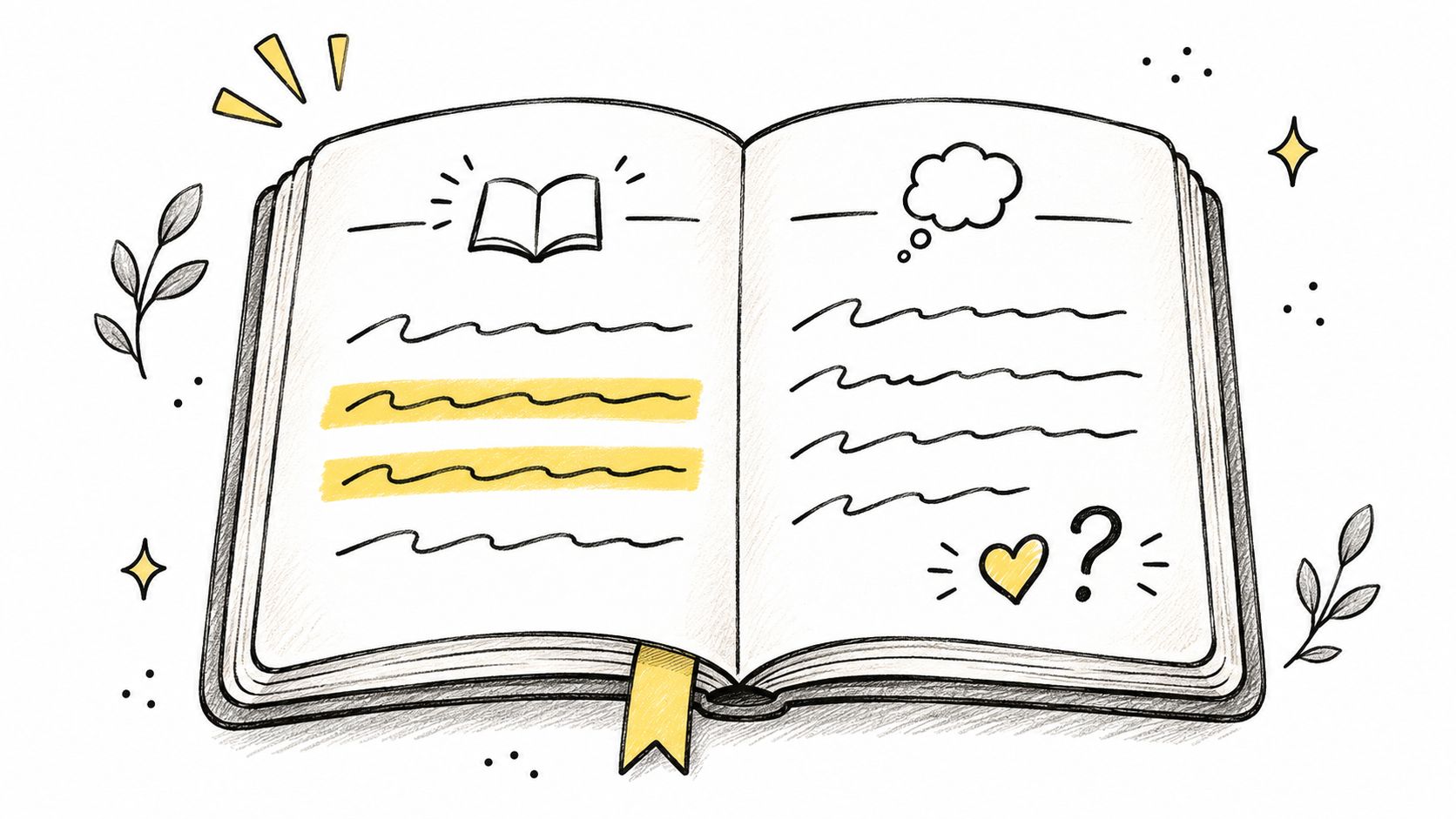
Turning a passage into a two-way exchange pays off most when you revisit those notes later. In experiments using brief texts by Karpicke and Roediger published through the Purdue University Learning Lab, repeated testing produced better one-week retention than a single test, and adding feedback through passage review improved outcomes further. Those experiments also found no meaningful retention advantage for expanding intervals over equally spaced retrieval, meaning the quality of your active recall and feedback matters more than chasing a complicated scheduling formula.
Keeping the Habit Sustainable Across a Whole Book
High school and college literature courses frequently require dialectical journals for every assigned novel, and lifelong readers adapt the exact same format when building a commonplace book that pairs quotes with personal commentary.
The biggest failure mode is ambition. Readers who try to journal ten quotes a night quit by chapter three. Cap yourself at one quotation and one written response per reading session so the habit stays realistic. For your saving step, save the highlighted quote with your reaction attached in the same note, and when the entry resurfaces in review, try to recall your response from memory before checking the original passage for feedback.
7. Rose, Bud, Thorn Reflection
Even people who read consistently struggle to maintain elaborate note-taking systems when work and family crowd the evening. According to The Reading Agency, 53% of UK adults described themselves as regular readers in 2025, up from 50% in 2024. If you read regularly and want a low-friction routine you won't abandon in two weeks, Rose, Bud, Thorn Reflection gives you a complete wrap-up after finishing the book in under three minutes.
Borrowed from team retrospectives, the prompt splits your reaction into three crisp categories:
- Rose: Name one passage, argument, or scene that stood out and earned its place in your memory.
- Bud: Capture one unfinished question, promising idea, or connected topic the book made you want to explore next.
- Thorn: Note one claim you doubted, a chapter that dragged, or a blind spot in the author's framing.
Book clubs use Rose, Bud, Thorn as a quick closing round so quiet members get the floor without pressure. Solo readers log one entry per finished book in a running journal instead of writing formal star ratings that tell them nothing six months later.
Spotting Patterns in Your Reading Taste
The obvious trade-off is depth. Rose, Bud, Thorn won't prepare you for a technical exam or help you dissect a dense philosophical treatise line by line. Its strength is consistency: a three-line reflection you finish beats an eight-page study guide you never start.
For your saving step, save your Rose highlight, Bud question, and Thorn observation together in a single note tagged to the book. After five or six titles, scan your saved entries side by side to spot what holds your attention, and export your Rose passages to Markdown whenever you want a ready-made list of quotes to share with friends.
8. Bloom's Taxonomy Question Ladder
Generic prompt lists tend to stall at the lowest rung of thinking: What is the main idea? That gets you a decent summary, yet it rarely helps you test an idea in real life or spot how it clashes with another author's work.
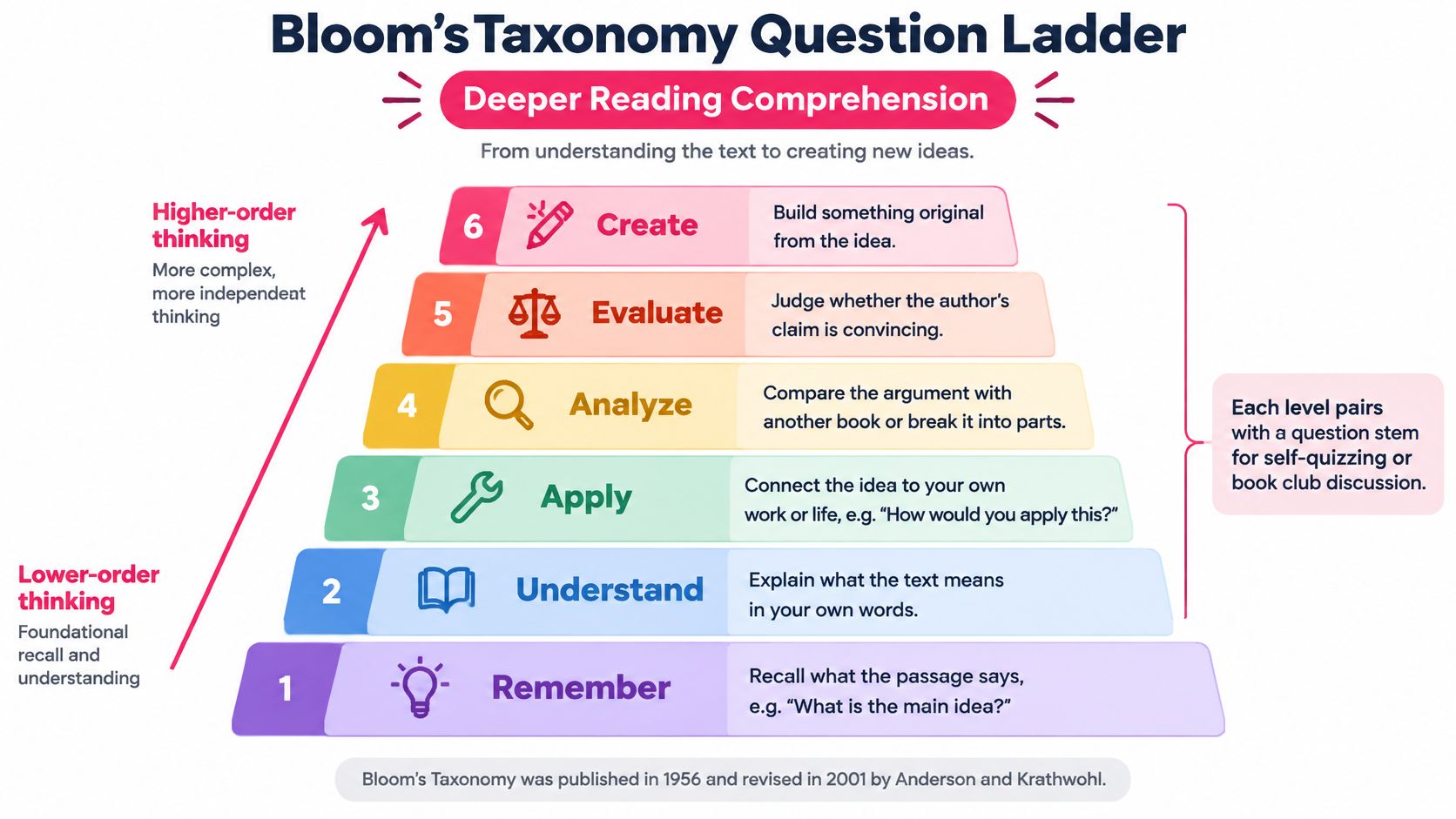
Bloom's Taxonomy Question Ladder gives you a structured climb after a chapter or after finishing the book. Built on Bloom's Taxonomy and later revised by Anderson and Krathwohl, it stacks six levels of cognitive demand from basic recall to original creation: remember, understand, apply, analyze, evaluate, and create.
The visual ladder below maps how each rung raises the mental effort required from your reading notes.
Adapting Prompt Difficulty Without Watering Down Ideas
A major advantage of a ladder is that you can adjust support without dumbing down the book. In a 2025 experiment involving 150 participants with dyslexia reported in an arXiv research paper, GPT-4-annotated texts improved recall of details, reading comprehension efficiency, and engagement compared with conventional and control conditions. That points to selective scaffolding: start on concrete retrieval (Which sentence best supports this idea?), climb to inference (What does this passage imply?), and finish with transfer (Where could this idea be tested in your life?), adding definitions or context only where a reader hits friction.
Working sequence: Use quick self-quizzes to verify remember and understand questions, then write your own answers for evaluate and create prompts.
Classroom teachers build unit quizzes with one question per rung, while self-directed learners draft a six-question study guide for any career-critical nonfiction book they finish. If your broader goal is learning how to remember what you read across months rather than days, climbing to the apply and create rungs gives your memory far stronger hooks than rereading ever will.
The trade-off is mental energy: running all six rungs after every chapter gets exhausting fast. Save the full ladder for cornerstone chapters or books you plan to reference at work. For your saving step, highlight the exact passage that answers your remember question, attach your apply or create prompt as the personal note, and test yourself on the lower rungs before revisiting your higher-level answer.
How the eight reading prompts compare at a glance
| Item | Best for | Time per session | Fiction or nonfiction |
|---|---|---|---|
| Question the Author (QtA) | Exploring author intent and interpreting passages | Slower, with pauses for questions | Fiction, nonfiction, and academic texts |
| Notice and Note Signposts | Spotting meaningful patterns and guiding discussion | Moderate, with pauses to mark signposts | Primarily fiction; adaptable to nonfiction |
| Literature Circles | Structured small-group book discussions | Ongoing preparation and group meetings | Fiction and nonfiction |
| Reciprocal Teaching | Building comprehension through prediction, questioning, clarification, and summarizing | Moderate; works with short sections | Fiction and nonfiction |
| Adler's Analytical Reading Questions | Analyzing and evaluating argument-driven books | Extended; may require multiple reading passes | Primarily nonfiction |
| Dialectical Journaling | Connecting reflections to specific passages | Flexible; one entry can be brief | Fiction and nonfiction |
| Rose, Bud, Thorn Reflection | Quick, balanced reflection after reading | A few minutes | Fiction, nonfiction, and academic texts |
| Bloom's Taxonomy Question Ladder | Moving from recall to deeper analysis and original thought | Moderate; question-writing takes effort | Fiction and nonfiction |
Turn One Prompt Into a Weekly Reading Habit
You finish a chapter, recognize a useful idea, and highlight it. Days later, you remember marking something but cannot explain it. Give that passage a question to return to. Start with one of these prompts for reading, rather than trying all eight at once.
A 2021 meta-analysis of 29 studies found an advantage for spaced retrieval over massed retrieval, with a standardized effect size of g = 0.74, as indexed in ERIC. Put that principle into practice by answering a saved question from memory before looking at the passage again.
Your Seven-Day Trial Routine
Choose the reading stage where you lose the thread, then pair your prompt with a saving step:
- Choose one timing stage: During a passage, use QtA, Signposts, or Dialectical Journaling and save the lines beside your question. After a chapter, use Reciprocal Teaching or Bloom's Ladder and save your answer with a supporting passage. After finishing a book, use Adler's Questions or Rose, Bud, Thorn and save your reflection alongside a passage that supports it.
- Set a daily floor: Work with one passage a day for seven days, keeping the passage and your written prompt or answer together. For an after-book prompt, revisit passages from the finished book rather than forcing a whole-book judgement onto each day's reading.
- Review before rereading: When the note returns a few days later, answer from memory, then check the highlight. Compare your answer with what the passage says.
Keep the saving step small.
Quotabl collects Kindle highlights, scanned paper-book passages, and pasted text in a searchable library. Its two-minute Daily Review shows a few highlights at a time, with kept highlights returning on a growing schedule. Margo, its reading companion, can recap a book or quiz you while citing your own highlights. You still need to attempt the answer yourself.
Stay with your first prompt until it feels automatic across a full book. Then add a prompt from another reading stage. To put the routine into practice, save your next passage in Quotabl and choose a reminder time and frequency you can sustain.

Written by
The Quotabl team
Makers of Quotabl
We make Quotabl, the app that syncs your Kindle highlights and brings them back with a daily review, a Home Screen widget and Margo, a reading companion. We write about reading, remembering what you read, and getting more out of your highlights.