
8 Book Club Ideas for Richer Discussions in 2026
The Quotabl team · · 13 min read

Everyone's settled in, the snacks are out, and you ask what people thought of the book. Everyone loved it. Someone mentions the ending, someone else praises the writing, and twenty minutes later you're discussing what to read next because nobody knows where to take the conversation.
The fix isn't necessarily a longer list of discussion questions. It's more concrete material. A sentence someone underlined, a paragraph that annoyed them, or a Kindle highlight they can't quite explain gives the group something specific to examine.
Saved passages also make preparation less intimidating. Members don't need a polished opinion about the whole book. They can bring a small piece of it and ask why the author chose those words, whether an argument holds up, or what another reader noticed.
Start with the words on the page. Let the larger conversation grow from them.
These book club ideas suit different groups: close readers, busy members who haven't finished, creative readers, and clubs that want to revisit earlier books. Each format starts with passages members already saved, whether they came from Kindle, a print book, or pasted notes. Choose the preparation rule and time limit that fit your group, rather than turning your next meeting into another assignment.
Table of Contents
- 1. Passage-Centered Discussion Circles
- 2. Highlight Swap Before Meetings
- 3. Theme Tracker Across the Book
- 4. Spaced Recall Quiz Night
- 5. Quote Card Challenge
- 6. Chapter Recap Relay
- 7. Shared Passage Library for the Club
- 8. Print Book Annotation Pass
- How the eight book club ideas compare by format, preparation and best use
- Pick One Format and Run It at Your Next Meeting
1. Passage-Centered Discussion Circles
Replace the opening round of general impressions with a passage round. Each member brings a highlighted excerpt and a sentence explaining why they saved it. Read the excerpt aloud before anyone interprets it, so everyone starts with the same text.

A qualitative study of three monthly book-club discussions found that members made increasingly longer contributions as relatively unstructured discussions progressed. That's a useful reason to leave room for interpretation rather than marching through a rigid questionnaire, though it isn't a guarantee for every group.
Run the Passage Round
- Prepare: Ask members to select a main passage and an optional backup from the agreed chapters.
- Set the limit: Allow five minutes per passage, including the reading. Offer everyone a turn before returning to a frequent speaker.
- Follow the language: Ask which word or detail supports an interpretation, then connect it to the larger story or argument.
Say you're reading a novel about estranged siblings. A member brings a description of an untouched dinner plate rather than the dramatic confrontation everyone remembers. Discussing that small detail can uncover a disagreement about whether the character feels grief, resentment, or relief.
Watch for miniature lectures. The person who chose the passage should introduce it, not deliver its definitive meaning. Invite another member to respond before the selector explains further.
Finish by choosing a passage worth revisiting after the next reading. Copy the selected excerpts into a shared document with their locations and brief notes. A Markdown export is useful when members want a portable record rather than another discussion trapped in a chat thread.
2. Highlight Swap Before Meetings
Two readers can finish the same chapter and save almost entirely different material. A highlight swap makes those differences the starting point, without asking anyone to defend their choices immediately.
Create a shared Google Doc or Notion page with a section for each member. Ask everyone to add a small selection of excerpts before the meeting, keeping commentary out of the first exchange. Kindle readers can follow this guide to export Kindle highlights, while print readers can type or scan their selections into the same document.
Compare Choices Before Interpretations
Set the submission deadline for two days before the meeting. Cap contributions at five passages per person, and allow only a brief tag, such as theme, question, or surprising.
Members then read the collection and arrive ready to discuss these differences:
- Overlap: Which passages did several people save, and did they save them for the same reason?
- Outliers: Which excerpt did nobody else notice?
- Missing context: Does an isolated highlight change meaning when the surrounding paragraph is restored?
For a nonfiction book about habits, one reader might save practical instructions while another marks the author's caveats. Give the opening fifteen minutes to that contrast. It can reveal whether the group is reading for application, persuasion, or criticism.
The failure mode is overload. An unedited export of every highlight isn't a useful invitation to discuss. Ask members to select deliberately rather than uploading their entire notebook.
Keep chapter names alongside page numbers or Kindle locations, because different editions won't line up neatly. If someone hasn't submitted anything, let them choose an excerpt from the shared list rather than making preparation a condition of entry.
3. Theme Tracker Across the Book
A theme tracker helps a club discuss development rather than collect isolated statements. Choose a few provisional themes before reading, then save passages that complicate them as well as passages that illustrate them.
For a novel, those themes might be memory, identity, and power. For nonfiction, they might be the central claim, supporting evidence, and exceptions. Keep the categories broad enough to accommodate surprises.
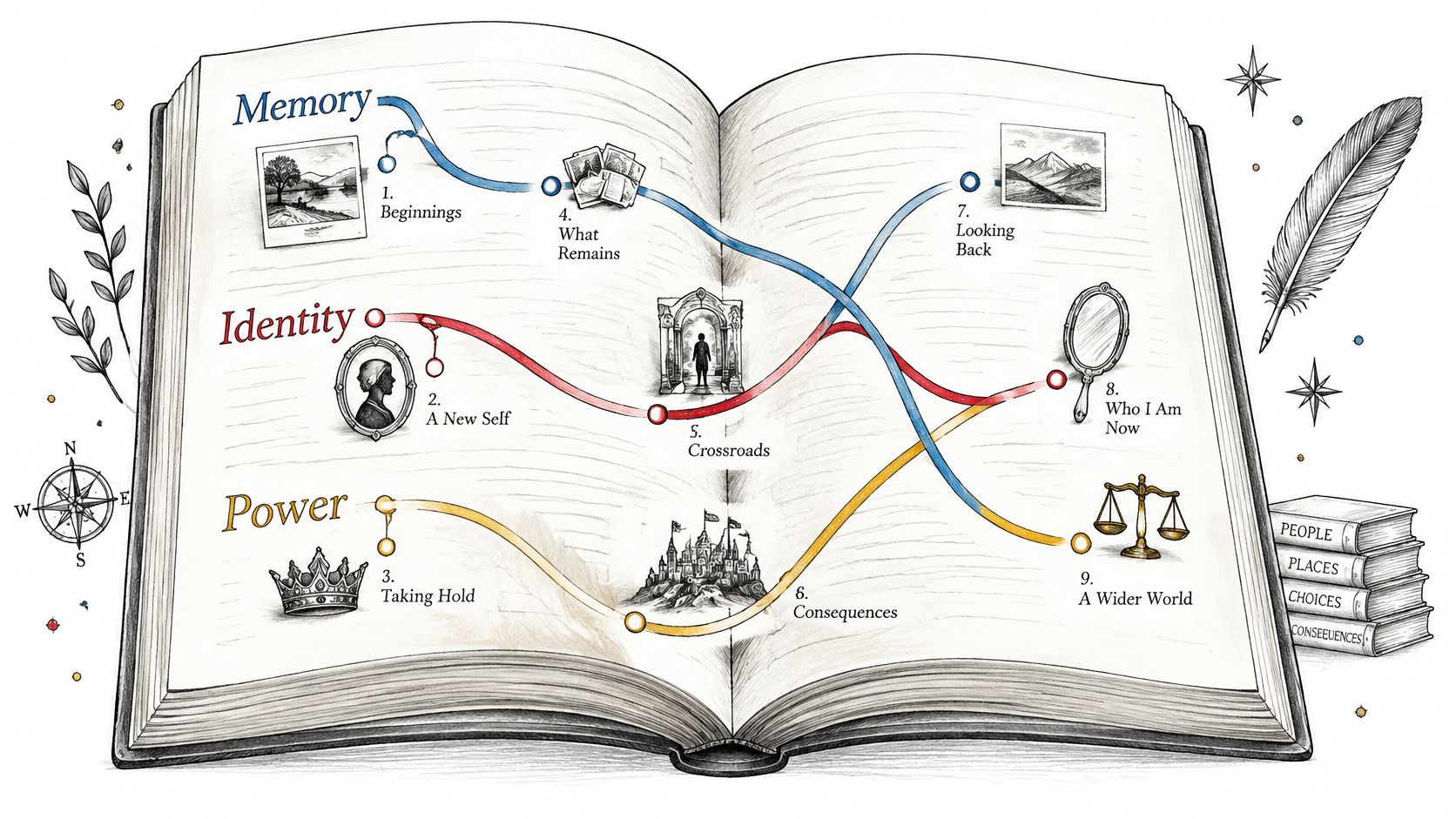
Build a Map That Can Change
Use a shared document organized by theme, with passages arranged in reading order. Each contribution needs the excerpt, its chapter or location, and a short note explaining the connection. Tag while reading, not only after finishing, so the map preserves changing impressions.
Cap the club at three themes and reserve twenty minutes after the final chapter for synthesis. Search saved passages for related keywords, but check nearby text before deciding that a keyword proves a thematic connection.
Say an early chapter presents silence as protection. Later, a character's silence enables harm. Put those passages side by side and ask what changed: the circumstances, the narrator's judgment, or the reader's understanding?
A useful theme map includes evidence that makes your first interpretation harder to defend.
Watch for confirmation collecting. Once members choose a theme, they may keep saving passages that support their original reading and ignore everything else. Give the facilitator responsibility for asking which excerpt most strongly challenges the map.
This format needs patience. It's less suitable for a casual drop-in session because its value comes from following an argument or story across the whole book. Let members rename a theme when the original label stops fitting.
4. Spaced Recall Quiz Night
Make this a review game, not a test of who deserves to belong. Use members' saved passages to create questions, let everyone answer from memory, and then reopen the text together.
For a self-improvement book, a useful question asks members to explain an idea and apply it to a situation. Recalling the author's exact terminology matters less than noticing when an application contradicts the original argument.
Write Questions Worth Answering
Rotate the quiz-writing role and ask the writer to keep an answer key linked to the original highlights. This guide to how to remember what you read offers a starting point for building review into a reading routine.
- Recall: Ask members to explain a distinction the author makes.
- Interpretation: Ask why a character's decision matters, using a saved passage as evidence.
- Application: Present a new situation and ask how the book's argument would apply.
Give the quiz ten minutes at the beginning of the meeting. Include a question from an earlier book, then spend at least as much attention checking the passages as announcing answers. Members should be allowed to pass or collaborate.
Suppose the group reads about setting boundaries. Ask how the author's advice would apply to a colleague who repeatedly requests last-minute help. After members answer, compare their proposals with the saved excerpt and identify any conditions they overlooked.
The failure mode is trivia without meaning. Obscure names and exact wording can turn a useful review into a memory contest. Avoid leaderboards unless the group explicitly wants competition, and accept different interpretations when members can support them with the text.
Keep disputed answers. They're often better discussion material than questions everyone gets right.
5. Quote Card Challenge
A quote card can reveal how a reader interprets a passage, not just how they decorate it. Ask members to turn a saved excerpt into a visual card, then explain what their design emphasizes.

Offer a plain template alongside decorative options. Members can use a quote card maker, Canva, or handwritten cards, but design skill shouldn't decide whose reading gets attention.
Judge the Reading, Not the Decoration
Keep excerpts short enough to read comfortably, and include the author and book title. Set a ten-minute preparation limit so the activity doesn't become a design assignment. At the meeting, give each member a brief turn to explain the passage before discussing fonts, colors, or layout.
For example, a member might place a seemingly hopeful sentence against a stark background because they read it as ironic. Another reader might see the same line as sincere. Return to the surrounding paragraph to test both interpretations.
- Preserve meaning: Don't remove a qualification just to make the wording fit.
- Keep participation accessible: Accept a text-only slide or an index card.
- Separate sharing from posting: Ask permission before publishing another member's card or identifying them online.
Watch for attractive misquotation. A polished graphic can make a fragment look more definitive than it is in context. Keep the original passage available and verify transcription before saving the finished card.
If the group wants voting, recognize thoughtful interpretation or a surprising selection rather than professional-looking design. Save the cards in a shared folder with locations attached, so the visual record still leads members back to the book.
6. Chapter Recap Relay
A member who has fallen behind can still join the discussion if the recap gives them a clear entry point. Assign rotating chapter recaps based on saved highlights and notes, rather than asking someone to improvise a plot summary.
Keep the Relay Short and Text-Based
Give the presenter three to five minutes. Ask them to read a passage, explain what changed in the chapter, and pose one open question. Display the excerpt so listeners can separate the author's words from the presenter's account.
For a business book, the presenter could explain a proposed decision-making method, read the paragraph that defines it, and ask which assumption might fail in a volunteer organization. For fiction, focus on a turning point instead of retelling every scene.
Set spoiler boundaries before assigning chapters. A member who has stopped halfway through should not learn the ending through an unannounced recap.
The main risk is treating highlights as complete coverage. A reader may have saved a vivid description but missed the chapter's central event or a qualifying detail. Ask another member to fill gaps, then check disagreements against the text.
If you compare the recap with an automated summary, check both against the book. A confident presenter or fluent summary can still miss a key passage.
Rotate assignments clearly. Otherwise, the same prepared member can become the club's permanent unpaid lecturer.
7. Shared Passage Library for the Club
A shared passage library gives the group somewhere to put excerpts it wants to revisit. Unlike a highlight swap, which serves the next meeting, this collection preserves connections across the club's reading history.
Choose a tool members already know, such as Google Docs, Notion, or a shared spreadsheet. Start with selected passages, not complete personal libraries, and decide who can view or edit the collection.
Give Every Entry the Same Shape
Use these fields consistently:
- Book and author: Make the source identifiable without opening another file.
- Passage and location: Include the chapter plus a page, ebook location, or audiobook timestamp where available.
- Member note: Explain why the passage mattered to the discussion.
- Theme tag: Choose a useful retrieval term, not a long string of labels.
Set aside five minutes at the end of each meeting to nominate additions. Assign a rotating librarian to remove duplicates, correct formatting, and export a Markdown backup at the end of the reading season.
Say the club later reads another book about ambition. Search the archive for that theme and compare a current passage with an earlier selection. New members can respond to both excerpts without needing a detailed account of the previous meeting.
The failure mode is building a storage project nobody uses. Don't require members to catalogue everything they read. A small, searchable selection is more useful than a sprawling archive with inconsistent labels.
Privacy needs an explicit rule, too. In survey reporting published by NBC Right Now, 56% of surveyed members said they keep their membership secret from people in their lives. Don't assume that permission to share a passage inside the club includes permission to publish someone's name, notes, or reading history.
8. Print Book Annotation Pass
Print readers shouldn't have to change formats to contribute searchable passages. Ask members to bring their marked-up books, then capture only the excerpts the group wants to discuss.

Agree on a simple marking system before reading: underlines for ideas, stars for questions, and margin notes for responses. Use removable sticky notes for borrowed copies, and don't write in a library book.
Capture Selectively, Then Compare
Ask each member to choose a passage before the meeting. They can type it into the shared document or scan it with a phone's text-recognition tool, then compare the result against the printed page.
- Check transcription: Look closely at punctuation, names, italics, and words split across lines.
- Record context: Add the chapter and edition information when page numbers differ.
- Ask before handling: Get permission before passing around someone else's annotated copy.
Give the comparison round fifteen minutes. Lay the copies open at the same scene and ask which details people marked, which they ignored, and whether their margin notes changed later.
Suppose several members underline a character's promise, but another circles the hesitant phrase just before it. That small difference gives the group a concrete question about reliability rather than another general discussion of whether the character is likable.
Watch for a scanning bottleneck. Capturing every annotation during the meeting wastes discussion time and encourages unnecessary transcription. Photograph or scan the chosen excerpt beforehand, then use the physical books to inspect context.
Don't treat the most heavily marked copy as the best reading. A single question on a sticky note can contribute more than pages of underlining without explanation.
How the eight book club ideas compare by format, preparation and best use
| Item | Best for | Preparation effort | Reading format |
|---|---|---|---|
| Passage-Centered Discussion Circles | Text-focused discussion and inclusive participation | Low; highlight passages while reading | Shared passages read aloud |
| Highlight Swap Before Meetings | Comparing readers' perspectives | Moderate; exchange highlights beforehand | Shared highlight list |
| Theme Tracker Across the Book | Following themes and patterns across a book | High; track passages by theme | Shared theme map |
| Spaced Recall Quiz Night | Retention and playful review | Moderate; create questions from highlights | Memory-first quiz |
| Quote Card Challenge | Creative, visual engagement and sharing | Moderate to high; design a quote card | Visual quote cards |
| Chapter Recap Relay | Catch-up and rotating participation | Low; use saved notes and highlights | Short chapter recaps |
| Shared Passage Library for the Club | Building a searchable record across books | Moderate; contribute and organize entries | Shared searchable collection |
| Print Book Annotation Pass | Paper readers comparing annotations | Moderate; mark and capture passages | Annotated print books and shared notes |
Pick One Format and Run It at Your Next Meeting
The strongest version of this approach isn't a meeting that includes a quiz, a design challenge, a recap relay, and a theme map. It's a meeting where members know what to bring and have enough time to explore it. Choose a single passage-based format, then make the preparation smaller than you think it needs to be.
For a quiet group, start with a passage-centered circle. For members who prefer thinking before speaking, try the advance highlight swap. If unfinished reading keeps people away, use the recap relay with an explicit spoiler boundary and permission to contribute from the chapters they've reached.
Make the First Trial Easy to Repeat
Send the invitation with the format, preparation rule, and time limit in the same message. Ask members to bring a saved passage, its location, and a brief explanation of why they chose it. Provide a shared document, but let people bring paper if that's easier.
Packaged preparation can be helpful: an assessment of a library Book Club-in-a-Bag program reported that 90% of respondents were highly satisfied. That result belongs to that program, but the practical lesson is worth testing: give members ready-to-use material instead of making everyone build their own preparation system.
After the meeting, ask whether preparation felt manageable, whether people had room to contribute, and which passage produced the most useful disagreement. Keep the part that worked and remove the part that felt like administration.
Organizer's rule: Change the format before asking members to work harder.
Keep the club's chosen passages in a single place, with source details and only the notes members agree to share. Quotabl offers book clubs 20% off with a club code, an option for groups that want Kindle syncing and highlights from different reading formats in one library.
Choose the next book for discussability as well as enthusiasm. If your group wants a genre change, browse these suspense thriller picks for 2026, then agree on spoiler boundaries before collecting excerpts.
For your next invitation, name the format and ask everyone to bring a passage they can't stop thinking about. That's enough material to begin. The facilitator's job is to help members examine it together, not arrive with every possible question already written.
Bring your Kindle highlights, scanned print passages, and pasted notes together with Quotabl, a reading companion for iPhone and Android. Collect the excerpts you want to discuss, export selected material for your club, and revisit those ideas between meetings through reviews and reminders.

Written by
The Quotabl team
Makers of Quotabl
We make Quotabl, the app that syncs your Kindle highlights and brings them back with a daily review, a Home Screen widget and Margo, a reading companion. We write about reading, remembering what you read, and getting more out of your highlights.