
How to Remember What You Read: Recall, Notes and Review
The Quotabl team · · 10 min read
You finish a nonfiction book with passages highlighted and the satisfying feeling that you've learned something useful. Later, someone asks what the author's central argument was, and you struggle to explain it. You remember enjoying the book. You might even recognize the page where the answer sits. But you can't produce the answer yourself.
Learning how to remember what you read starts with separating familiarity from recall. Instead of judging a reading session by how clear the text felt, check what you can explain when the text is out of sight. Then use your mistakes to decide what to save, what to practice, and when to return.
Table of Contents
- Remember What You Read With a Closed-Book Routine
- Why Rereading Feels Right but Does Not Stick
- Test Recall Before You Check the Page
- Keep Notes Usable Across Kindle, Print and Articles
- Space Your Reviews Over Days and Weeks
Remember What You Read With a Closed-Book Routine
The most useful change happens at the end of a reading session, before you move on to something else. Don't start by polishing notes or collecting more quotations. Start by finding out what you can reconstruct.
A review of learning techniques indexed by PubMed rated practice testing as high utility, while highlighting and rereading received low-utility ratings. The practical distinction is simple: testing asks you to generate an answer, whereas looking at a highlighted passage leaves the answer available.
You don't need to turn every book into coursework. Choose ideas you want to use, discuss, or retain, then give those ideas a brief closed-book test.
Follow the routine without peeking
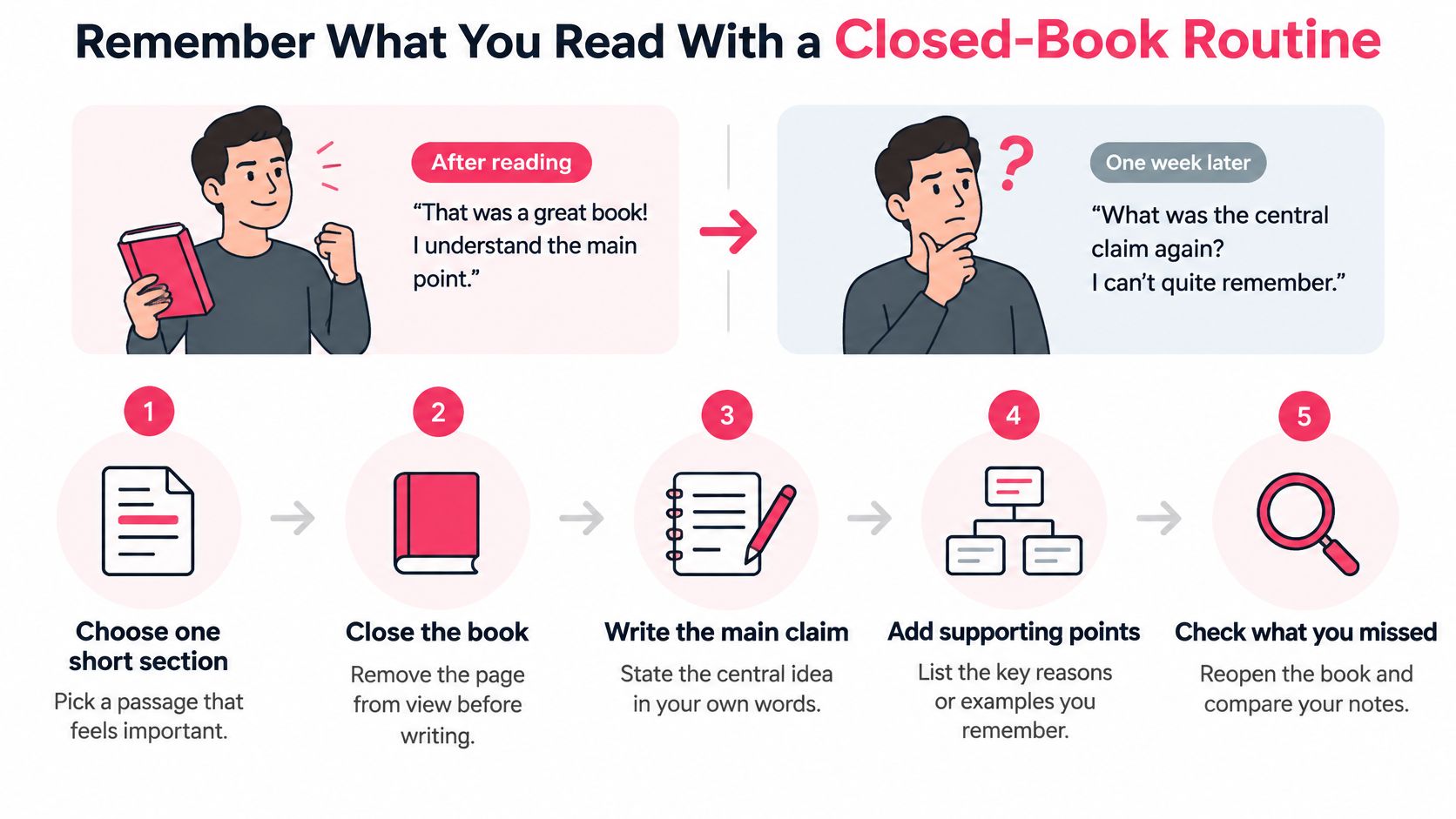
Choose a short section that makes a complete point. Stop after an argument, explanation, or worked example rather than automatically waiting for the chapter to end. A useful stopping point gives you something coherent to reconstruct, without demanding that you hold an entire chapter in mind.
Close the book and move it out of reach. Hide your highlights and notes too. If you glance at the page whenever you hesitate, you won't find out whether you could have supplied the missing idea yourself.
Write or say the claim, mechanism, and example from memory. What does the author argue? Why should it work that way? What concrete case makes the explanation understandable? Plain language is preferable to a half-remembered sentence that sounds impressive but means little to you.
Reopen the text and check your reconstruction. Mark omitted points as missed, incomplete explanations as partial, and contradictions as wrong. Correct the substance immediately, especially when you felt certain about an answer that the text doesn't support.
Turn gaps into questions for later. Include a question about what the author claims, another about why or how it works, and an application question. Save the answers separately so you can attempt the questions without seeing the passage first.
This visual summarizes the move from reading to reconstruction and checking.
Make the questions specific enough to answer
Suppose you've read a passage arguing that teams should distinguish reversible decisions from decisions that are costly to undo. A weak note would merely label the topic as decision-making. That label doesn't tell you what to retrieve.
A better question asks how reversibility should change the amount of checking before a decision. Your answer should explain the relationship, not just repeat the term. An application question could ask which pending decision at work you could safely treat as an experiment.
If almost nothing comes back, reduce the size of the reading section or give yourself a narrow cue, such as the problem the author was trying to solve. Don't respond by repeatedly rereading the entire chapter. You're trying to make recall possible, not make the page more familiar.
Practical rule: An imperfect answer gives you something to correct. A copied answer doesn't tell you what you know.
Keep the setup small
A paper notebook and calendar are enough. If you prefer digital tools, compare apps for readers by how easily they let you preserve context and revisit questions, not by how many passages they let you collect.
In Quotabl, connecting a Kindle imports your books, highlights, and notes, usually in under a minute; our Daily Review shows a few highlights at a time and takes two minutes. Whatever tool you choose, make your own recall attempt before studying the saved wording.
Tonight, try the routine on a meaningful section you've just finished. Put a follow-up in tomorrow's calendar and another about a week later. Treat a prompt closed-book attempt as a practical habit, not as a scientifically established deadline beyond which your reading is lost.
Why Rereading Feels Right but Does Not Stick
In his 1885 self-experiments, Hermann Ebbinghaus measured how much learning time he saved when relearning lists of meaningless syllables, with approximate savings declining from 58% after 20 minutes to 21% after 31 days, as described in the account of the forgetting curve. The intermediate results below help show the pattern: the early decline was steeper than the later decline.
Savings on relearning after each delay
| Time since reading | Savings on relearning | What it means for a finished book |
|---|---|---|
| 20 minutes | 58% | Forgetting can begin soon after learning |
| 1 hour | 44% | Don't assume recently read material is securely available |
| 1 day | 34% | An early recall check is a useful precaution |
| 6 days | 25% | Returning later may require substantial reconstruction |
| 31 days | 21% | Plan a return rather than assuming lasting access |
These figures describe relearning time saved, not the percentage of a book someone could consciously recall. The table's reading advice is a practical interpretation, not a measurement of readers finishing nonfiction books. Ebbinghaus tested himself on unfamiliar syllables, and the exact forgetting pattern changes with the material, learning conditions, and prior knowledge.
You therefore can't conclude that a book finished on Sunday will be mostly gone by Tuesday. You can conclude that finishing it doesn't establish how much you'll be able to retrieve later.
Why a familiar page gives false reassurance
On a second reading, the author supplies the vocabulary, sequence, examples, and conclusion again. You follow along smoothly because the explanation is in front of you. That smoothness can feel like mastery even when you couldn't reconstruct the argument unaided.
Highlighting can contribute to the same mistake. A marked sentence tells you where you noticed something important, but it doesn't establish whether you remember why it mattered.
Suppose you highlight passages throughout a business book, then reopen it before a meeting. Every marked sentence looks familiar. Yet when a colleague asks why the author recommends a particular strategy, you can offer the recommendation but none of the reasoning.
Familiarity answers whether you've encountered the passage. Recall answers whether you can supply its meaning without it.
Rereading still has a job: use it to repair a specific omission or misunderstanding after an attempt. The problem isn't opening the book again. It's treating an easy second encounter as proof of learning.
For your first return, choose a near-term opportunity, such as the next day, rather than leaving the book untouched until next month. Make that return an attempt to generate the argument before checking it.
Test Recall Before You Check the Page
Confidence is useful only when you compare it with accuracy. Feeling certain about an explanation doesn't make the explanation correct, and hesitating doesn't necessarily mean you've forgotten it.
A Web Highlights discussion of the Roediger–Karpicke testing experiments describes the mismatch: rereading produced greater immediate confidence, while self-testing produced better delayed recall after a week. That's a reason to measure what you can produce, rather than using certainty as your only guide.
Separate the answer from your prediction
Before revealing a saved passage, answer its question and record your confidence. Use simple labels such as unsure, somewhat sure, or confident. Then check the text and record correctness separately.
Don't give yourself a pass just because your answer contains the author's terminology. Check whether you preserved the actual claim, its qualifications, and the reasoning behind it.
Three outcomes to check before you reveal the passage
| Outcome | Test prompt | Passing sign |
|---|---|---|
| Gist recall | What is the author's main claim? | You state it in a sentence without looking |
| Explanation | Why does the claim hold, in your own words? | You give the mechanism and a concrete example |
| Application | Where would this change a decision you face this week? | You name a real situation and what you would do differently |
These outcomes aren't interchangeable. You might remember that an author favors small experiments without being able to explain when an experiment is appropriate. Or you might explain the principle well but struggle to identify a sensible use for it.
For other ways to turn reading into something you actively do, TTS Pro on active learning offers a companion resource. Keep the same standard when choosing an activity: it should require an answer or explanation, not another encounter with the material.
Let the mismatch guide your next move
A confident but wrong answer deserves careful correction and a sharper question. Perhaps you've confused the author's claim with a related idea, or overlooked an exception. Don't lengthen the review interval just because answering felt easy.
An unsure but right answer deserves another opportunity to establish dependable access. It isn't evidence that you know nothing, but it isn't a reason to stop checking either.
End each review with a short log: confident and right, confident and wrong, unsure and right, or unsure and wrong. Add the specific correction where needed. That record tells you more about what to practice next than a growing highlight count does.
Keep Notes Usable Across Kindle, Print and Articles
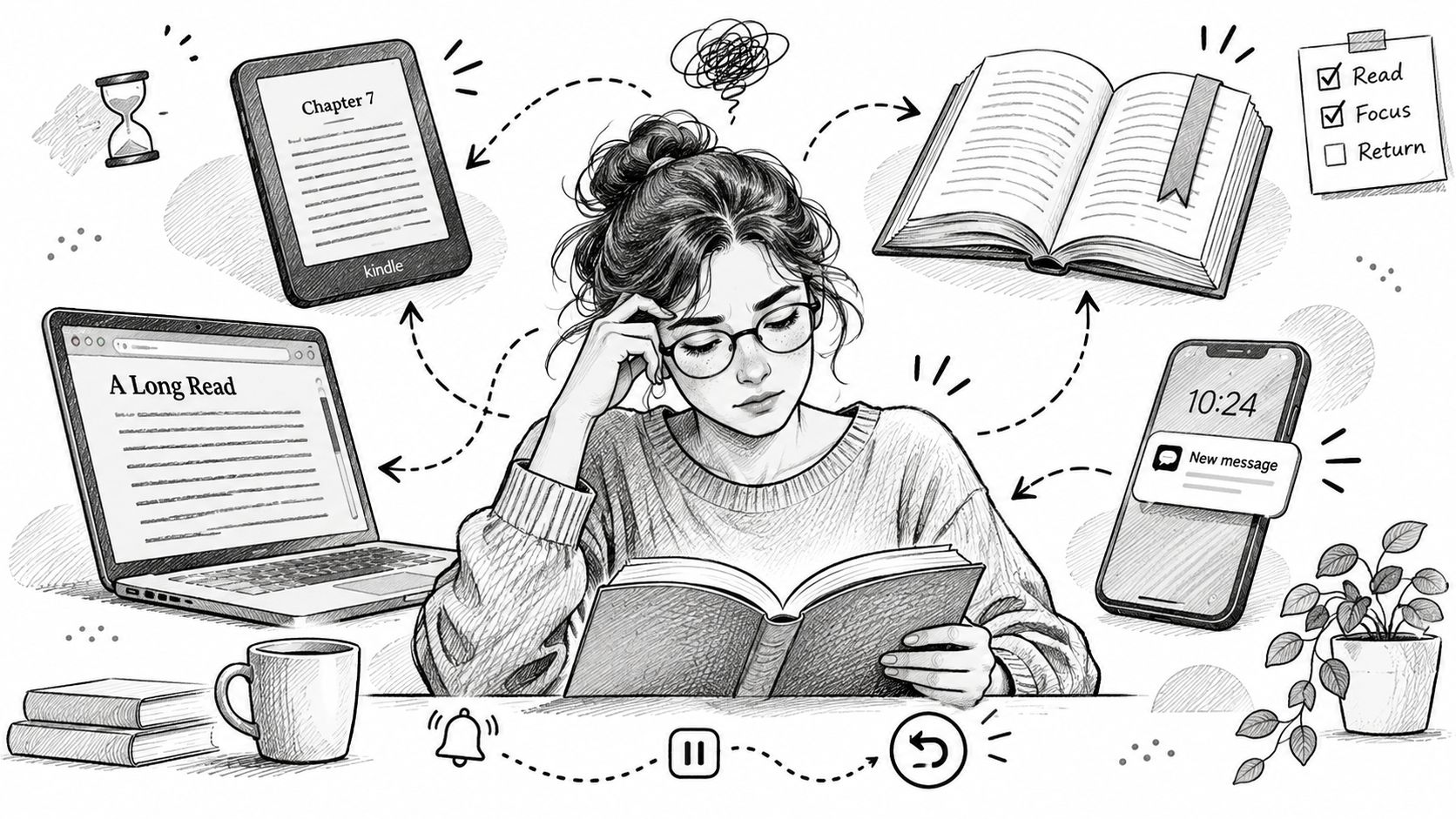
Your reading probably doesn't happen in a single uninterrupted sitting. You might begin with a Kindle book, continue with a printed copy, open an article on your phone, and return after answering a message. The challenge is keeping enough context to understand what each saved passage was doing.
Distraction doesn't have an identical effect in every setting. A 2025 eye-tracking study published in the Journal of Computer Assisted Learning found no significant comprehension difference between reading with and without on-screen distractions under its tested conditions. That doesn't establish that every interruption is harmless, or that you should ignore difficulty reconnecting with a text.
Leave yourself a route back into the argument
Before switching tasks, capture the important passage and add a context tag: the book or article, the relevant chapter or section, and the question the passage answers. When you return, hide the passage and reconstruct what the author was trying to establish before continuing.
The aim is to preserve more than an attractive sentence. You need enough surrounding meaning to distinguish the author's conclusion from an example, objection, or claim they later reject.
Use a consistent note structure across formats:
- Record the location. Include the print page, Kindle location, or article section so you can inspect the surrounding explanation.
- Name the argument. Tag the note with the claim it supports, not just a broad subject such as productivity.
- Select rather than transcribe. Keep notes that help reconstruct the chapter's argument instead of preserving every appealing line.
- Separate facts from explanations. Distinguish what happened from the author's account of why it happened.
- Check sideloaded material separately. Books you added yourself, including sideloaded files and documents, don't appear in the Amazon Kindle notebook. The guide to exporting Kindle highlights explains the relevant export routes.
Make the note understandable later
Suppose your original note says only that reversible decisions need less checking. Later, you may not remember whether this was the author's recommendation or a position they criticized.
A usable context tag might read: Decision-making book, chapter on uncertainty. Answers how much evidence to gather before acting. The author recommends lighter checking when a mistake can be cheaply reversed.
That tag gives your future self a question, a position, and a boundary. You can now test the idea without guessing what the isolated passage meant.
Space Your Reviews Over Days and Weeks
Spaced study produced 47% recall versus 37% for massed study across a review of 254 studies involving more than 14,000 participants, according to a cognitive-psychology review of effective learning techniques. The useful lesson isn't that every reader will achieve those percentages. It's that distributing practice deserves a place in your routine.
Use a workable schedule
The review schedule below is a practical starting point, not a promise that these intervals are optimal for every book. At each return, answer before checking and distinguish a complete answer from a partial or missing one.
Review schedule after each reading session
| Review | When | What you do |
|---|---|---|
| 1 | Right after reading | Recall the main claim and an example, then check the page |
| 2 | Later the same day | Recall again and mark each item correct, partial, or missing |
| 3 | One to two days later | Recall the claim, explain it, then apply it |
| 4 | About one week later | Recall, then mix in a related idea from another chapter |
| 5 | Several weeks later | Recall; retain useful items and shorten the interval for unsuccessful ones |
For an accessible illustration of why returning matters, use the forgetting-curve tool. If you're preparing for a test, Zemith's guidance on how to stop cramming before exams provides additional scheduling context.
Adjust to performance: After an error, return sooner. After repeated successful attempts, leave a longer gap.
Occasionally mix related topics. For example, ask how a reversible decision differs from a low-consequence decision, rather than practicing each definition in isolation.
Avoid reviewing so soon that you're merely repeating an answer still in view, counting a reread as a successful test, or scheduling more questions than you can realistically attempt. Keep the queue selective: an idea worth revisiting should earn its place through usefulness, not merely because you once highlighted it.
Quotabl brings Kindle highlights, scanned print passages, and manually entered notes into a library you can revisit through scheduled reviews and reminders. Visit Quotabl, collect a passage you want to retain, and pair it with a question you'll answer before checking the original.

Written by
The Quotabl team
Makers of Quotabl
We make Quotabl, the app that syncs your Kindle highlights and brings them back with a daily review, a Home Screen widget and Margo, a reading companion. We write about reading, remembering what you read, and getting more out of your highlights.