
Commonplace Book: What It Is and How to Keep One
The Quotabl team · · 14 min read
A commonplace book is a personal notebook where a reader copies or notes passages, sorts them under topical headings, and keeps them for later use. The best-known system for one came from John Locke, who built his method over roughly 25 years of note-taking, published it in French in the 1680s, and saw an English edition printed in 1706.
Your e-reader almost certainly holds a few hundred highlights. You made them in the moment, when a line felt sharp enough to keep, and now they sit in a list ordered by the date you tapped the screen. Here's the harder question. Which three of them changed something you did last month?
That gap between saving and using is the problem the commonplace book was invented to solve. Not the saving half. The returning half.
Table of Contents
- What a Commonplace Book Is in Plain Terms
- How Collecting, Sorting and Revisiting Fit Together
- Where the Commonplace Book Came From
- Organizing Entries With Headings and Indexes
- Commonplace Books in Real Practice
- Making Saved Passages Stick Through Revisiting
- Where a Commonplace Book Falls Short
- Start Your Commonplace Book This Week
What a Commonplace Book Is in Plain Terms
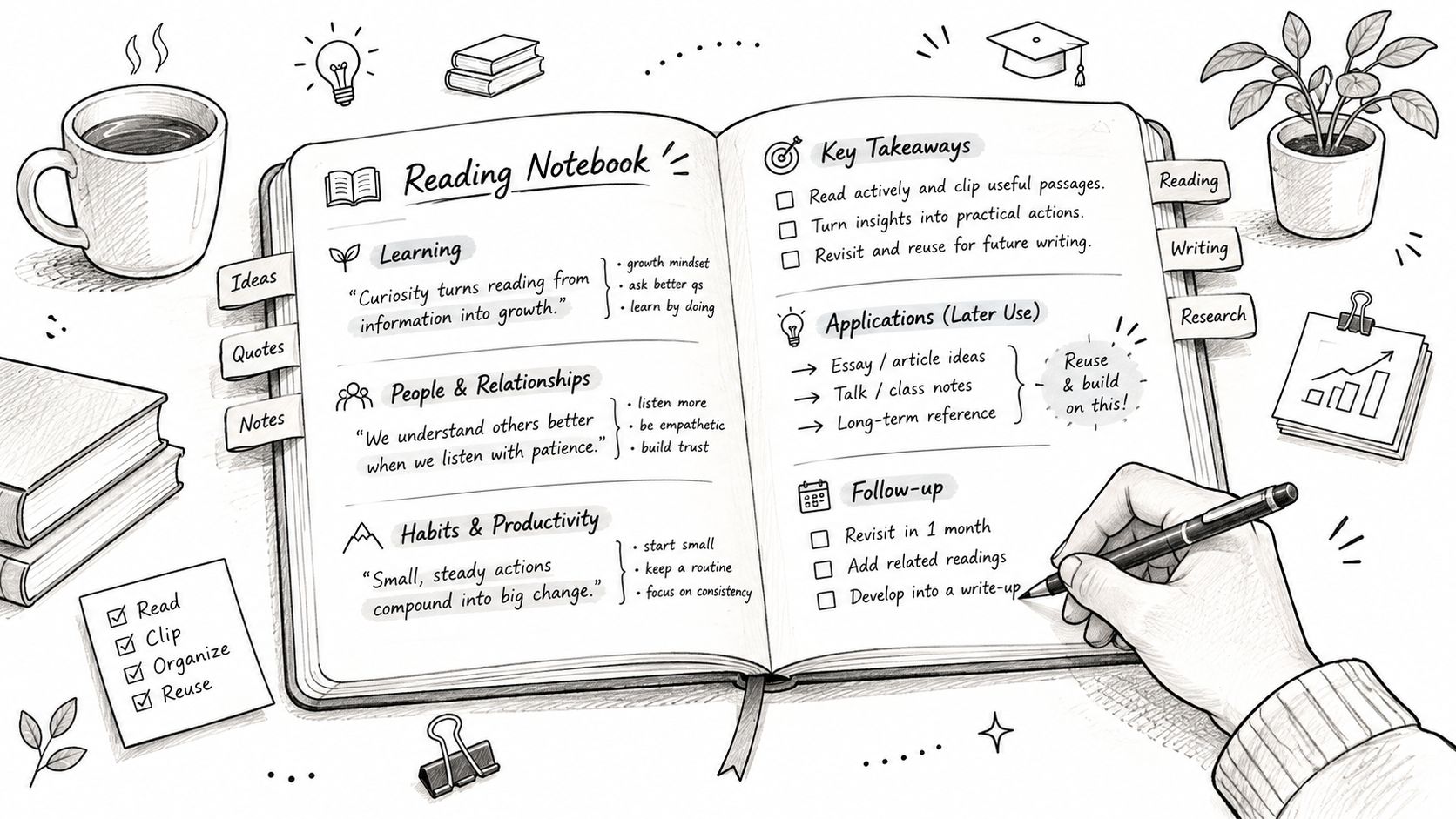
Think of a recipe box. You drop cards into it for years, sorted by course or by cuisine, and when dinner needs deciding you pull out three and choose one. The box looks modest. It works because every card has a home and a reason to be there.
A commonplace book is a recipe box for sentences. The card is a passage you copied. The tab on the card is the heading you filed it under. The act of cooking from it is the writing, discussion or decision you make later.
Historians treat the form as a personal information-management system rather than a quotation diary, and the distinction matters. A study abstract in the English Historical Review describes the practice as extracting passages, assigning them to topical headings and preserving them for later recall, reuse and composition. The same source notes that in Georgian England, owners recorded not only verbatim extracts but also their own comments and questions, which made the notebook a working dialogue between reader and text.
So the historical commonplace book contained three things at once: the borrowed words, the heading that located them, and a response in the owner's own hand.
Journals and highlight lists are different tools
A journal is organised by date and points inward, at your own life. A highlight list is organised by whatever order you read in and points at nothing in particular, because a mark with no heading and no response is a bookmark pretending to be a note. A commonplace book points outward, at ideas, and organises them by subject so you can find them again by meaning rather than by date.
The container barely matters. A clothbound notebook, a single document, or a library inside an app all qualify, as long as passages, sources and headings stay together in one place.
The test: do you want to reuse what you read in writing, study, discussion or decisions? Then keep a commonplace book. If you only want a record of what you read, a reading log will serve you better and cost you less work.
How Collecting, Sorting and Revisiting Fit Together
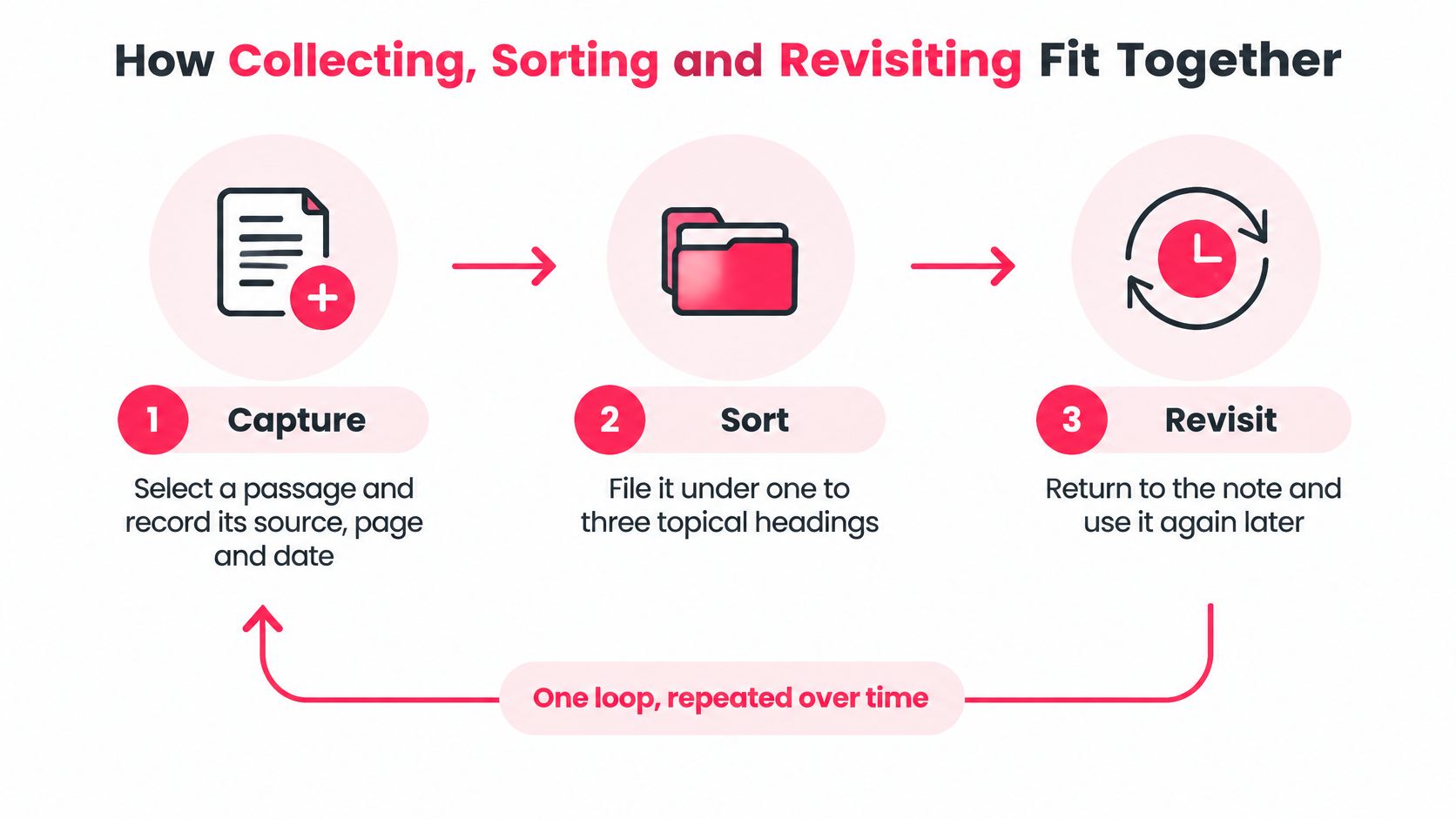
The practice runs as a loop, not a shelf. Capture means selecting a passage and recording where it came from. Sort means filing it under one to three headings. Revisit means coming back to it and doing something with it, in an essay, a meeting, a lesson plan or a purchase.
Each stage exists to make the next one possible. Selective copying forces you to interpret while the page is still open in front of you. Topical headings give you a way in when memory fails. Returning to the entry lets an idea from one book collide with an idea from another, which is where most original thinking starts.
| Stage | What You Do | What It Gives You | Common Failure |
|---|---|---|---|
| Capture | Copy the passage with book, author, page and date | A source trail you can check and cite | Copying without a source, so the quote cannot be verified |
| Sort | File the passage under one to three headings | Retrieval cues for later search | Inventing too many headings, so none get reused |
| Revisit | Reread a sample of entries and write a response | Ideas you can apply in writing or decisions | Never returning to entries, so the archive stays inert |
What breaks each stage
Capture fails. You paste a line into a document, the page number vanishes, and six months later you can neither quote it nor check whether you remembered it correctly. Sorting fails through enthusiasm. A reader creates a new heading for every entry, ends up with 40 headings used once each, and has effectively built a chronological list with extra steps. Revisiting fails through silence, because nothing in a paper notebook ever taps you on the shoulder.
If you want to see how other people solve the sorting half, this scored ranking of note taking apps compares the tools on structure and search rather than on looks.
Quick diagnostic: if you can't find a passage in under a minute, your sorting is the weak stage. If you find it instantly and it never changes anything you do, your revisiting is.
If your raw material currently lives in an e-reader, start by learning how to export Kindle highlights into a single library, because capture is much easier once every passage lands in one place you can search.
Where the Commonplace Book Came From
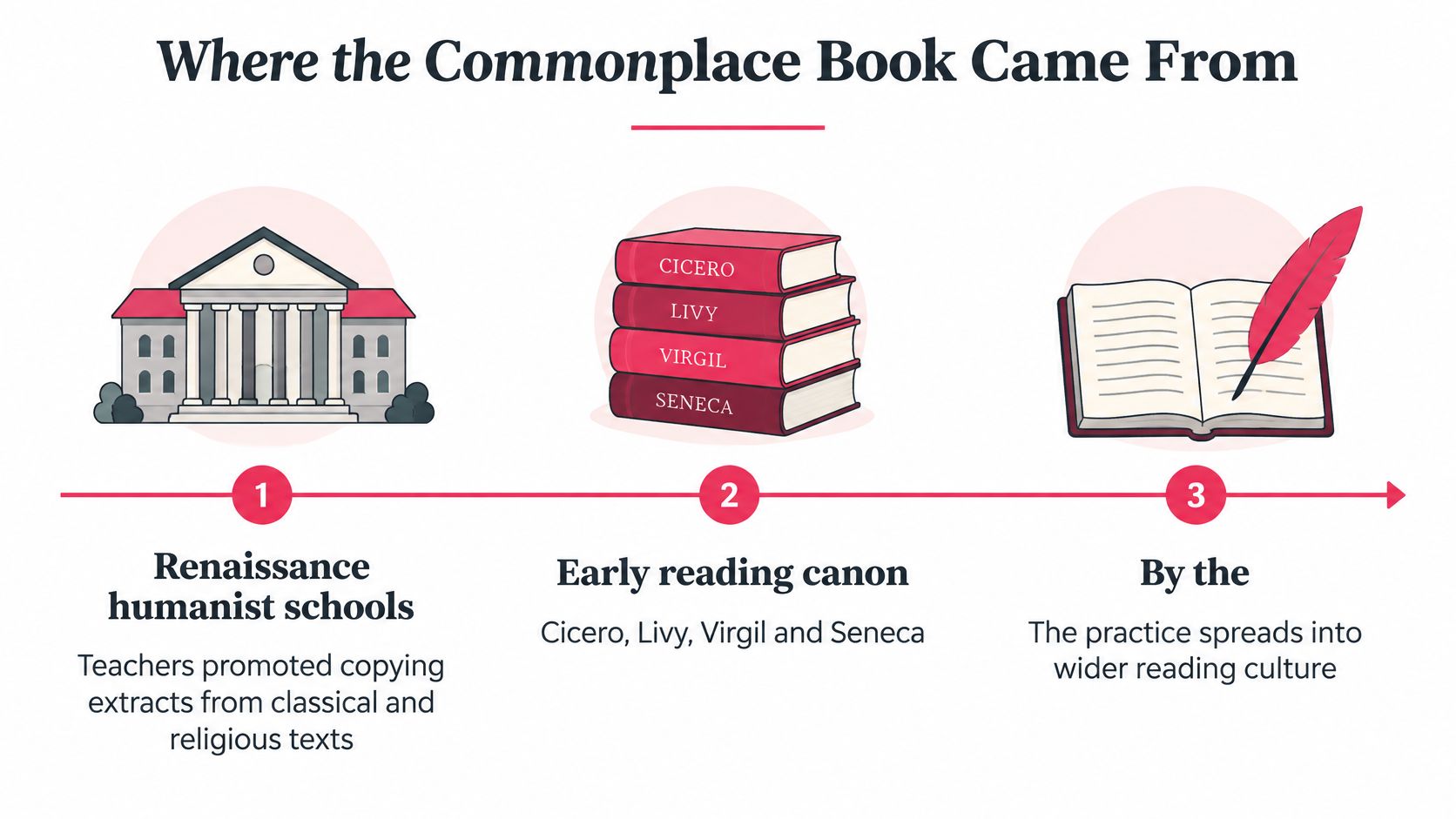
The form began as classroom technology. Renaissance humanist educators promoted notebooks for collecting extracts from major classical and religious texts, and students were expected to copy, not merely read, as a Griffith University research repository study sets out. Copying was the pedagogy. A line you had written out by hand was a line you had begun to own.
From four authors to every subject
Early contents centred on a narrow canon: Cicero, Livy, Virgil and Seneca. Then the wall came down. By the late fifteenth century the practice had expanded into law, politics, science, poetry and prose, according to the same repository study, which turned the commonplace book from a literary exercise into a general-purpose personal knowledge system for readers well beyond the schoolroom.
The notebook was cumulative by design. It wasn't aimed at a finished work. One volume could grow for years as its owner met new sources, which means a surviving commonplace book reads like a map of a lifetime of reading rather than a single argument.
The keepers were not only men
Surviving scholarship has identified commonplace-book activity among women including Sarah Cowper, Lady Katherine Ranelagh, Elizabeth Lyttelton, Sarah Horsington, Ann Bowyr and Lady Anne Southwell, as the same study records. That list matters for a practical reason. It shows the practice flexing to fit different lives, different libraries and different purposes long before anyone wrote a rulebook for it.
Why it read as an early search engine
The historical significance sits in the combination of reading, selection, classification and retrieval. A commonplace book was an early analogue to a searchable quotation database, with one catch: the search engine was handwritten. Access depended entirely on the quality of the owner's headings, margins and index. A careless indexer built a haystack. A careful one built a library.
The habit has now survived a change of medium roughly every century, from manuscript to print to screen, because the underlying job never changed: collect what matters, label it well, come back to it. A reader today can use the same method with no more equipment than a notes app.
Organizing Entries With Headings and Indexes
John Locke supplied the most influential early-modern system, and it's worth understanding because it solves a problem you still have. He developed it through approximately 25 years of personal note-taking, starting in his Oxford years, and published it in French in the 1680s before the English edition, A New Method of Making Common-Place-Books, appeared posthumously in 1706, as described in a study of Locke's indexing method.
The mechanism replaced chronological note-taking with an expandable subject index. Each entry got a prominent head, meaning a topic. You then located that topic by its first letter plus the vowel that followed it, using the five vowels A, E, I, O and U. A heading beginning with E and followed by I went into that index division. The scheme let a notebook grow without anyone having to reserve space for every future entry in advance.
That's the whole trick, and it's why the method lasted. Recording and retrieving were separated, so you could file today without knowing what you'd need in ten years.
The five fields every entry needs
Locke had a paper index. You can keep the same logic with a handful of fields, whether you write on paper or in an app.
| Entry Field | Purpose | Example |
|---|---|---|
| Heading | Groups the entry by topic | Attention and habit, not the book title |
| Source line | Lets you check and cite the passage | Book title, author, page and date |
| Your note | Records your reaction or question | Does this hold for adult learners? |
| Aliases | Catches synonyms for later search | Focus, attention, concentration |
| Cross-link | Connects related entries across books | Points to the entry on deliberate practice |
The rule that keeps an index usable
Before you create a new heading, look at the ones you already have. Duplicate headings are the fastest way to make an archive unsearchable, because the same idea ends up split across three near-identical labels and none of them feels complete.
Keep the index in one place, even if the notebook lives in several apps. One lookup point means one place to check.
Practical rule: three headings per entry is the ceiling. If a passage seems to belong everywhere, it belongs under the heading you'll be thinking about next month.
Two mechanical details trip people up. Books you added to a Kindle yourself, such as sideloaded files or documents, don't appear in the Amazon Kindle notebook, so export from the device's own clippings file instead. And whatever system you build, keep an exit: our library exports as Markdown with one section per book from the You tab, so your entries stay portable if you change tools.
Commonplace Books in Real Practice
A history student reads a seventeenth-century sermon and copies one line under the heading Authority, with a note about why a congregation should trust a preacher's tone. Four months later she is writing about persuasion in political speeches. She remembers the heading rather than the quote, finds the entry, and uses the sermon line to show that the argument is older than she assumed. The retrieval worked because the heading predicted the question she would eventually ask, and her source line carries the page number because her priority is exact wording.
A nonfiction reader keeps a heading called Decisions. One entry holds a passage about how teams default to the loudest voice in a room, plus a note about a Tuesday meeting where he did exactly that. The entry preserves no beautiful sentence. It records a small change in behaviour, which is the point of saving it.
A book club member keeps one notebook per club year, with a heading for each book. She brings two passages to every meeting and reads them aloud with the page reference, so anyone can follow up. Her headings double as a discussion guide, and her notes are written for an audience rather than for memory.
Three readers, three purposes. None of them is storing quotes for the sake of storage.
One entry, three different jobs
The student values fidelity to the text. The nonfiction reader values a record of what changed. The club member values prompts that start conversation. All three needs are served by the same six lines, which is why the template is worth memorising rather than redesigning.
Model entry Heading: Habit Source: Book title, author, page 114, read 12 March Passage: the author argues that a routine survives only if the cue is attached to something that already happens daily My note: disagrees with the bit about motivation, but the cue point matches how I stopped losing my keys Revisit: 12 June
The Revisit line is what turns the entry into a system rather than an archive. Without it, the passage is collected once and never comes back. With it, the entry has a scheduled next appearance, and the note has a job to do when the passage returns.
Here is a paste-ready version for any notes app or paper page. It takes about two minutes to fill in for a first entry.
- Heading: one to three plain topic words, never the book title
- Source: book, author, page, date read
- Passage: the claim in your own words, or the exact line if the wording matters
- My note: one application, one objection or one connection
- Revisit: a fixed date, written down now
The club member's workflow adds one more step. When a passage is worth bringing to the group, she turns it into a shareable quote card so the wording and the attribution travel together. The card is for the meeting. The entry stays in the notebook, where the revisit date will bring it back long after the discussion ends.
Making Saved Passages Stick Through Revisiting
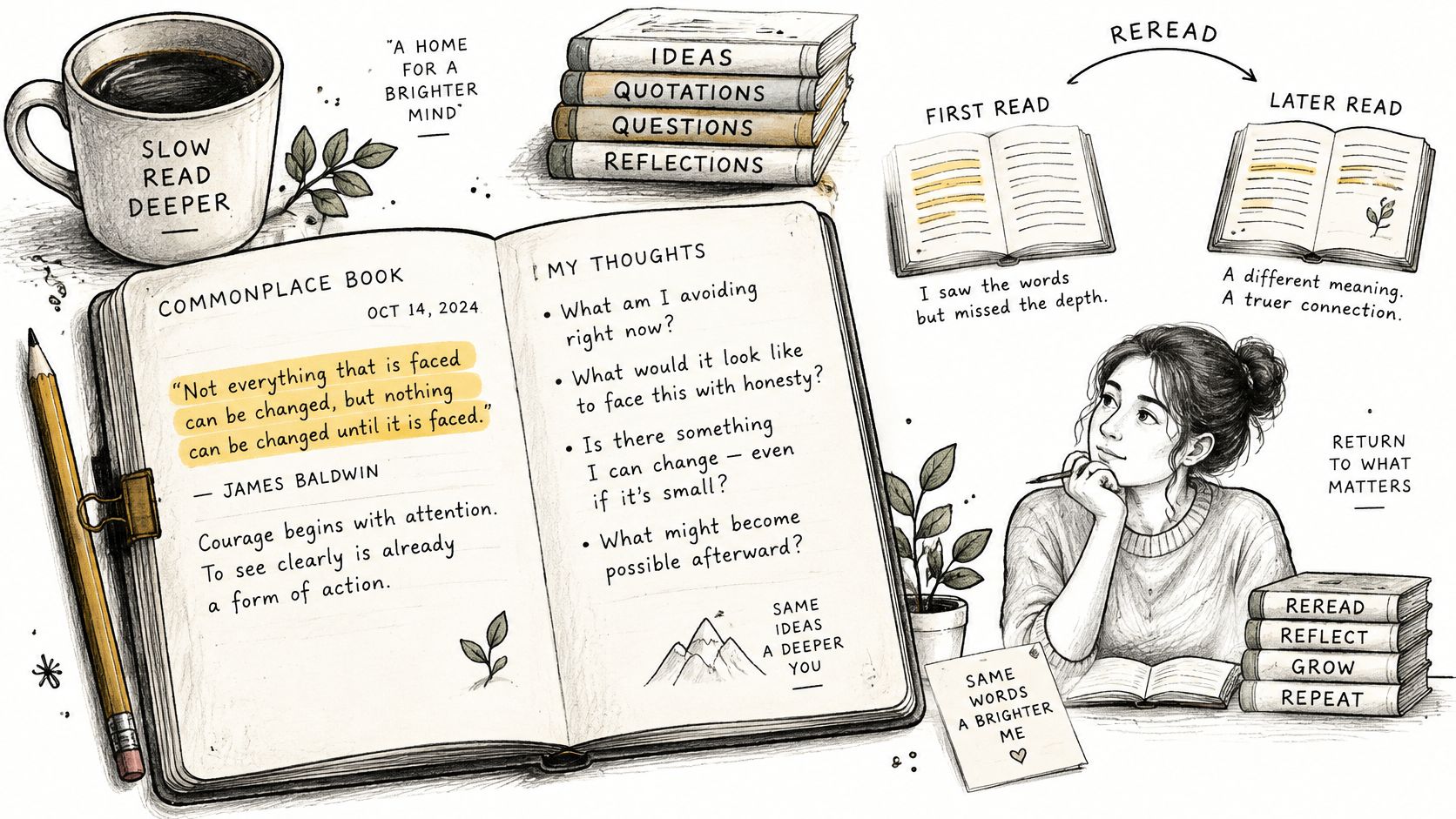
The revisit is the stage most systems skip, and it's the one that decides whether you have a knowledge base or a storage unit. Historical readers wrote comments and questions beside their extracts, so response was built into the tradition from the start. A chapter in an Oxford University Press collection on annotation makes the case sharply: students in the cited study created substantially more annotations on paper than electronically, yet neither highlighting nor annotation significantly improved subsequent memory. Marking is a record of attention, not a mechanism for remembering.
The fix is to make the revisit an active test rather than a reread. You reconstruct the idea from memory, then correct your reconstruction against the source.
The five-step review
- Pick two or three entries you haven't looked at in a month. Two is enough. Consistency beats volume.
- Hide the quotation and write what the author was arguing, in one or two sentences, in the entry's own note field.
- Compare your version with the original passage. Note what you dropped, softened or got wrong.
- Write one response: an application, an objection or a connection to something you already know.
- Set the next revisit date on the entry so the loop continues without a decision from you.
Steps two and four carry all the value. Step three is where the correction happens, and correction is what makes memory stick.
Three prompts that do the work
Use these at the reconstruction stage and again at the response stage.
What was the author arguing? Do you still agree? Where could this idea change a decision?
The third prompt is the one many readers never ask, and it's the one that turns a saved quotation into changed behaviour. It also surfaces the entries that aren't earning their place, which is useful for pruning later.
Set a fixed date rather than reviewing whenever the mood arrives. A routine that depends on enthusiasm dies in a busy fortnight. In our Daily Review, highlights you keep return on a growing schedule and ones you don't keep appear less often, which handles the scheduling without willpower.
If you want to see why the gaps matter, this explanation of the forgetting curve shows what happens to unreviewed material in the weeks after you close the book.
Where a Commonplace Book Falls Short
Four ideas about commonplacing cause most of the disappointment, and each one is worth correcting before you spend a month on the habit.
It is not a scrapbook of favourite quotes. Every entry needs a source and a reason to return. If you can't say why you'd want to meet the passage again, it's decoration.
More highlights do not mean more memory. Marking a line records where your attention went. It doesn't build recall on its own, and treating a growing highlight count as progress is the most common self-deception in the whole practice.
A neat index does not replace rereading. A perfectly organised notebook that nobody opens is a beautifully labelled archive of unread material.
You don't need a special notebook or the right system. Locke's index is a good scaffold, not an entrance exam. A document with six headings beats an unused leather journal.
The limits worth knowing
Paper is slow to search. Retrieval depends on handwritten headings and indexes, and a page number you forgot to write can't be recovered later. Large archives need periodic pruning, because headings multiply over time and a long list stops being a lookup tool. Fast-moving subjects can also outpace a slow capture habit, which is why a study-notes system and a commonplace book rarely want to live in the same container.
One test before you keep anything: does this passage have a reason to be revisited? A checkable source, a heading that earns its place, and a question you actually want answered. Miss all three and leaving it out is the better decision.
The system works when response matters more than collection. That's the whole difference between a notebook that sharpens your thinking and a folder that fills up.
Start Your Commonplace Book This Week
Set thirty minutes aside once, and you'll have a working system rather than a plan.
- Choose the container. Paper notebook, single document, or a library in an app. Passages, sources and headings must live together.
- Write five headings drawn from the book you're reading right now, in plain topic words rather than chapter titles.
- Capture three passages, each with a source line carrying book, author, page and date.
- Write one note per passage. A question, a disagreement or an application.
- Book the first ten-minute revisit for later this same week, and run the three prompts when it arrives.
If you read on an e-reader, check the export route before you start, because that choice decides how much of the capture step you do by hand. Connecting a Kindle brings your books, highlights and notes into Quotabl, usually in under a minute, and the Daily Review shows a few at a time and takes two minutes. If you're also trying to rebuild a lapsed writing habit alongside this one, this guide to fixing a stalled journaling habit pairs well with weekly review.
Keep the first session short enough that you finish it. A complete set of five entries is worth more than a beautiful unfinished notebook, and the first month is what decides whether the archive ever becomes useful.
Your highlights already contain the raw material for a commonplace book. Quotabl is an app for iPhone and Android that gathers passages from Kindle books, paper books and your own notes into one searchable library, then brings them back through a two-minute Daily Review, a Home Screen quote and scheduled reminders. Keep what earns its place and the rest fades, so the archive slowly becomes a record of what you think. Visit Quotabl to connect your first book and write the opening entry today.

Written by
The Quotabl team
Makers of Quotabl
We make Quotabl, the app that syncs your Kindle highlights and brings them back with a daily review, a Home Screen widget and Margo, a reading companion. We write about reading, remembering what you read, and getting more out of your highlights.