
Book Club Discussion Questions: 10 Prompts for Any Book
The Quotabl team · · 16 min read
Someone asks the question every club asks first: "So what did everyone think?" Two people answer. One says the ending felt rushed, another says she liked the sister. Then the room goes quiet, someone refills a glass, and the host starts talking about the next book.
The group isn't the problem. The question is. "What did everyone think?" has no entry point, and the follow-up that would rescue it, "What made you think that?", never arrives because nobody has a page number ready.
A discussion question earns its place when it points at something specific in the book and gives a quiet member a way to answer without performing.
The ten formats below are sorted by what they do in the room, not by genre: anchoring talk in a passage, assigning preparation roles, comparing books, testing an author's argument, staging a moral choice. Each one comes with a question you can use at your next meeting, and each one says whether it suits fiction, nonfiction, or both. A quick poll that boosts attendee participation before the meeting also settles the date and tells you who finished.
Table of Contents
- 1. Passage-Anchored and AI-Assisted Highlight-Based Discussion Questions
- 2. Socratic Seminar Questions
- 3. Literature Circle Role Prompts
- 4. Publisher and Celebrity Book Club Discussion Guides
- 5. Bloom's Taxonomy Discussion Questions
- 6. Notice and Note Signpost Questions
- 7. Harkness Method Discussion Questions
- 8. Reader-Response Questions
- 9. Thematic Comparison Questions
- 10. Hypothetical and Ethical Dilemma Questions
- How the ten book club question formats compare
- Choose One Format and Bring It to Your Next Meeting
1. Passage-Anchored and AI-Assisted Highlight-Based Discussion Questions
Start with a sentence on the page, not a theme in the air.
The most reliable opening move I know is to put one passage in front of the group and ask what it's doing. Members take turns reading a marked line aloud, then talk about the wording, why the author chose those words, and how the passage connects to the book's larger argument or story. The questions come from what readers highlighted, so nobody has to hold the whole book in their head to say something useful.
A good prep session looks like this.

- Rotate the reading. A club working through a memoir picks three highlighted passages and has a different member read each one aloud before anyone comments.
- Test the claim. A nonfiction group pulls highlights from a business or self-help book and checks the author's evidence against what members have seen at work.
- Build the agenda from the group. Each member brings three highlights, and the host turns the five most repeated ideas into that meeting's question list.
Rule I keep: every quote gets a follow-up that pushes past admiration, such as "What does this reveal about the narrator?" Otherwise the group nods at a beautiful line and moves on.
The payoff shows up in satisfaction. A library assessment of the Book Club-in-a-Bag program reported that 90% of survey respondents were highly satisfied, and respondents named having all the materials together as helpful, particularly the discussion questions. Passages plus prompts, packaged as one asset, beat a bare list.
If you draft questions with an AI tool, check every one against the text before you use it. A model will invent a scene that reads plausible, and the group will spend ten minutes on a passage that doesn't exist. Search or export your saved highlights the night before so quotes are easy to find in the room. Readers who keep a digital commonplace book already have the material sorted by book and theme, which cuts prep to about ten minutes.
Study groups have worked this way for years, which is why collections of small group questions on covetousness are built around specific verses rather than general topics. The text is in front of people, so the discussion lands.
Best for: both. Fiction gains from line-level analysis; nonfiction gains from testing an author's evidence against lived experience.
2. Socratic Seminar Questions
Three good questions beat forty decent ones.
A Socratic seminar is leader-light by design. Members respond to open-ended questions about a text and then to each other's ideas, while the facilitator mostly listens and asks follow-ups. The questions aim at several valid interpretations and climb from what the text says to what it implies and why it matters. The method draws on the Socratic dialogue tradition and reached classrooms through Mortimer Adler's Paideia Proposal.
Room setups vary. School programs influenced by Paideia run seminars on classic texts, and adult clubs borrow the inner and outer circle: half the group discusses for fifteen minutes while the others observe and take notes, then they swap and the observers open with what they heard.
The temptation with book club discussion questions is to print a giant list. BookClubs.com publishes a list of 124 questions, updated in 2025, and it's a fine emergency backup. A seminar runs on three to five, written in advance, with no yes-or-no options anywhere.
Facilitator move: let the silence run four or five seconds before stepping in. The third pause is usually where the real answer comes from.
- Write the core set. Three to five questions, ordered from what happens to what it means.
- Bank the good ones. Assign one member to note which questions produced the most engagement, so next month's prep starts from evidence.
- Resist rescuing. A follow-up question does more work than a summary of what someone just said.
Best for: both, though nonfiction seminars work best on a book with an argument worth attacking.
3. Literature Circle Role Prompts
Hand out jobs, not questions.
In a literature circle, each member takes a defined role and prepares from that angle. The discussion director writes questions, the passage picker chooses lines, the connector links the book to the wider world, the vocabulary finder flags language, and the summarizer tracks the arc. The group's questions then come from several perspectives instead of one host's notebook. The model was developed in classrooms and later adapted for adult reading groups.

Middle and high school classes rotate roles across a novel unit. Adult clubs use a lighter version: a discussion director who brings five questions and a connector who brings one news story that echoes the book's central problem.
The trade-off: roles make preparation uneven. The summarizer has an easy job and the discussion director has the hardest one, so rotate every meeting and let the load even out.
- Give each role a card. One page, two or three sample questions, so nobody shows up guessing.
- Cap the sharing. One or two minutes per role keeps the meeting from becoming six monologues.
- Skip a role if the group is small. Four people and five roles produces awkward silence.
More formats for filling a calendar of meetings live in this collection of book club ideas, including themed rounds that give each role something fresh to work with.
Best for: both, but roles shine with fiction that has clear narrative building blocks.
4. Publisher and Celebrity Book Club Discussion Guides
Free guides arrive with the book, and that's both the appeal and the trap.
Oprah's Book Club, running since 1996, publishes discussion questions and author Q&As with its selections, and Reese's Book Club posts a guide for each monthly pick. Paperback editions from the major houses often carry a reading group guide in the back. The demand is measurable: Penguin Random House's Reader Lounge research reported that 81% of surveyed avid readers were interested in receiving discussion guides. That page was updated in 2026.
Whether a guide gets used depends on the questions inside it. A University of Groningen research project on reading guides identifies the discussion-questions section as the part that particularly stimulates reflection and the exchange of ideas, and describes it as the foundation for cultural transfer inside a reading group. Guides built on plot recall do the opposite: they turn a meeting into a quiz.
- Read the guide early. Pick three or four questions that fit your members and drop the rest without guilt.
- Write two of your own. The publisher doesn't know who is coming to your house.
- Check for spoilers. Some guides assume everyone finished, and a reveal in question one ends the evening.
The publishing industry writes most of these guides for fiction, because fiction is what clubs buy in multiples. Memoir, history, and big-idea nonfiction do get guides, usually with fewer questions and more background material.
Best for: both, with the caveat that a celebrity-club guide is written for readers who finished the whole book.
5. Bloom's Taxonomy Discussion Questions
Move up the ladder in one meeting.
Questions arranged by cognitive level begin with recall and move through understanding, application, analysis, evaluation, and creation. A group can walk the whole set in an hour, starting with what happened and ending with what they would build or change. Benjamin Bloom introduced the framework in 1956, and Lorin Anderson and David Krathwohl revised it in 2001.
The gap between lower and higher levels is real. Research on question types in literature circles classified prompts across the six cognitive levels and reported that lower-level questions occurred more often than higher-order ones, with the distribution of question types changing significantly according to a chi-square test. Related reading-group research sorted prompts into four categories (emotional response, interpretive response, mental imagery, and connections between real life and the narrative) with 5 to 7 questions in each.
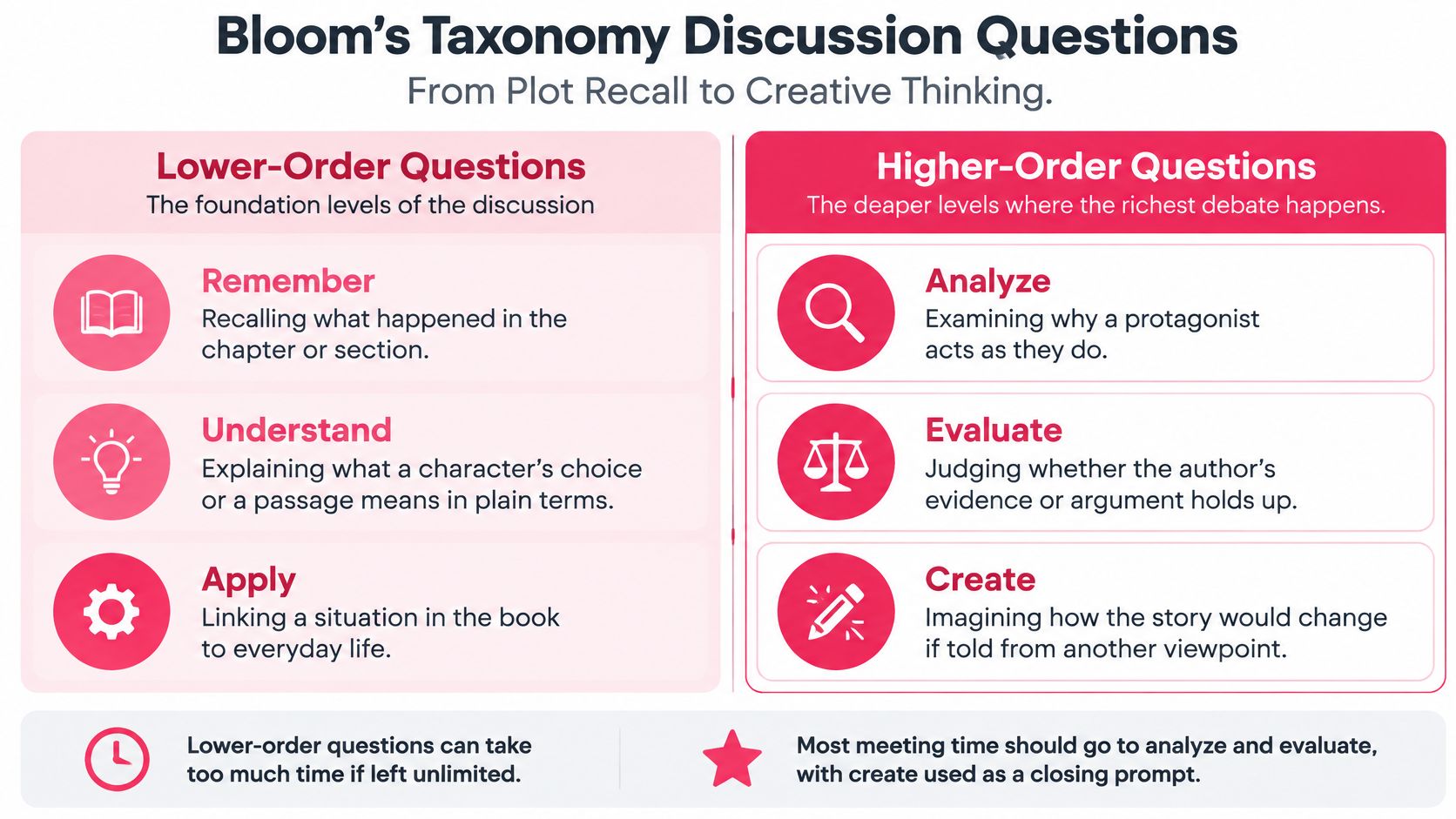
A workable pair for a novel: "What does the protagonist want in the first chapter, and what does she need?" then close with "How would this story change if the antagonist told it?" A nonfiction study group uses the evaluate level where it belongs, asking whether the author's evidence would survive a hostile reviewer.
Practical rule: write one question per level, then spend most of the clock on analyze and evaluate, where the disagreement lives.
Save the create-level question for the last ten minutes. It sends people out talking.
Best for: both. Fiction rewards the analyze and create levels; nonfiction rewards evaluate.
6. Notice and Note Signpost Questions
Six signposts, and you only need two per meeting.
The approach gives readers six markers of narrative importance and a question attached to each: contrasts and contradictions, extremes and exaggerations, aha moments, tough questions, words of the wise, and again and again. Kylene Beers and Robert Probst developed it for classroom reading instruction, and it translates well to any group interested in how a story is built rather than only what happened.
Run it this way. Members mark signpost moments in the text before the meeting, then the host picks two or three to discuss. A club reading a literary novel spots a character behaving against type and asks what the contradiction reveals about her values. A classroom unit uses the aha moment to slow down a character's sudden realization and ask what changed.
- Introduce the six briefly. One sentence each is enough for adults.
- Let members find their own. A signpost someone else identified never lands as hard as the one you marked yourself.
- Two or three per discussion. All six turns the meeting into a checklist.
Why it works: a signpost question points at a specific paragraph without telling anyone what to think about it. The group arrives at meaning together instead of receiving it from the host.
Skip the signposts for most nonfiction. They're a fiction tool, tuned to how novels signal importance, and forcing them onto a memoir's chronology produces busywork.
Best for: fiction, and only fiction.
7. Harkness Method Discussion Questions
Put twelve chairs in an oval and the conversation changes.
The Harkness method was developed at Phillips Exeter Academy, where participants sit around a table and discuss a text as equals while the teacher joins as another voice rather than a lecturer. Questions stay open, and the direction emerges from the group's own responses. The point is collaborative inquiry, with every member holding a share of responsibility for whether the hour goes well.
Phillips Exeter runs Harkness tables in English and history courses. Adult groups borrow the seating and the norms rather than the whole apparatus: a circle, a shared text, no head of the table.
- Circle the chairs. Any setup with a head position creates a person who talks last and least.
- Set one norm. Respond to the previous speaker before adding a new idea. That single rule cuts the number of abandoned threads.
- Keep a tally. Mark who has spoken, then invite the people with no marks.
Counting works better than reminding. A host with a tally sheet can draw out the two people who haven't spoken instead of asking the loudest member to hold back.
The format needs a group of eight to fourteen to work. Below six, it turns into a normal conversation with better chairs.
Best for: both, and especially strong for nonfiction where the group is weighing an argument together.
8. Reader-Response Questions
Ask about the reader, not just the text.
Reader-response prompts focus on what happened inside the person holding the book: how a passage made them feel, what they expected, and how their own background shaped what they saw. Reader-response theory treats that experience as legitimate evidence, not a distraction from analysis. It's also the fastest way to explain why two members read the same chapter and came away with opposite reactions.
For a family drama, ask which character each member identified with and why. For historical fiction, ask how their knowledge of the period changed the reading, and whether the novel corrected or confirmed what they already thought.

The social stakes are higher than they look. A 2025 report on book clubs and younger readers cites survey data showing that 63% of surveyed U.S. club members joined to socialize, 59% to make new friends, and 93% said the experience was therapeutic. The same report draws on NielsenIQ data from the UK showing that adults aged 25 to 34 were especially likely to discuss books online, while older adults led in-person discussion. Personal questions are how a group becomes a group.
- Pair feeling with evidence. Follow "I couldn't stand her" with "which scene made you feel that?"
- Let people pass. A norm that anyone can skip a question protects the members who came for the book, not a therapy session.
- Ask about expectations. "What did you expect to happen?" surfaces assumptions nobody knew they had.
Reader-response prompts do their best work with character-driven fiction, the kind of interior novel you'd find when you browse sapphic literary fiction picks. For a technical nonfiction book, they need a different frame. And if you want more ways to turn a passage into a personal question, these prompts for reading give you a starting set.
Best for: fiction, and memoir. Use sparingly with argument-driven nonfiction.
9. Thematic Comparison Questions
Compare two books, not ten.
Comparison prompts connect the current read to other texts, authors, genres, or a live issue. Members compare characters, structures, or arguments across books, or ask how the book speaks to something in the news. The format widens the discussion past a single title and gives a series-reading group a reason to keep its backlist in play.
A club that reads two novels about immigration asks how each author handles family loyalty. A nonfiction group sets the author's argument beside a documentary or a long article on the same topic and asks whose evidence holds up.
The format matters more than most lists admit, because clubs themselves are changing. In the 2025 State of Reading report from Everand, 43% of nonparticipants said they prefer choosing books independently, while 30% expressed interest in a customizable club where members read what they want. A comparison question is what holds a self-selected group together when nobody read the same title.
- Cap the comparison. One or two other titles per meeting, or the current book disappears.
- Use saved passages. Pull a line from last month's book to draw the link out loud.
- Keep a running theme list. A shared note of recurring ideas lets the group spot patterns across a year.
Contrarian note: rigid questions may be part of why people avoid clubs in the first place. A prompt that sounds like homework keeps the curious reader home.
Best for: both, and the only format on this list that works when members read different books.
10. Hypothetical and Ethical Dilemma Questions
Stage the choice, then let them argue.
Dilemma prompts drop characters or readers into a moral situation: what would you have done, what should the character have done, and which values drive your answer. These questions force positions and defenses, which is why they generate the sharpest debate of any format here. Use them with fiction built on morally complex people, or nonfiction about ethics, leadership, and social policy.
A club reading a crime novel asks whether the detective's shortcut was justified. A nonfiction group reading about a contested historical decision asks members how they would have acted under the same pressures, then compares their answers with what the record shows.
The disagreement is worth capturing. A book club feedback survey template organizes discussion quality into engagement, facilitator effectiveness, comfort sharing views, stimulation of new ideas, relevance to the selected book, adequacy of member-contribution time, and active participation frequency, and suggests seven-point scales plus one open-text question about which prompt generated the most productive disagreement. That last question is the one I'd keep if I could only keep one.
Closing move: ask what evidence would change each person's mind. It ends the argument without declaring a winner.
- Agree on ground rules first. Respectful disagreement is a norm you set before the meeting, not a rule you invoke mid-heat.
- Make one person argue the opposite. Sixty seconds on the other side loosens a fixed position.
- Protect the quiet ones. A dilemma can turn into a contest between the two most confident speakers if you let it.
Best for: fiction with ambiguity, and nonfiction on ethics, leadership, or policy.
How the ten book club question formats compare
| Item | Best For | Preparation | Works for Nonfiction |
|---|---|---|---|
| Passage-Anchored and AI-Assisted Highlight-Based Discussion Questions | Text-focused discussion grounded in members' highlights | Select passages and prepare or review questions | Yes, works across genres |
| Socratic Seminar Questions | Close reading and debate with shared participation | Prepare open-ended questions; facilitator guides lightly | Yes, when the text supports interpretation |
| Literature Circle Role Prompts | Shared contributions from members with varied discussion styles | Assign rotating roles and prepare notes | Yes, with roles adapted to the subject |
| Publisher and Celebrity Book Club Discussion Guides | Ready-made questions and an easy starting point | Choose relevant questions from an existing guide | Yes, if a guide is available |
| Bloom's Taxonomy Discussion Questions | Moving from basic comprehension to deeper analysis | Prepare questions across cognitive levels | Yes, including evaluating an author's evidence |
| Notice and Note Signpost Questions | Analyzing narrative moments and turning points | Identify signposts and select a few to discuss | Limited; designed primarily for fiction |
| Harkness Method Discussion Questions | Collaborative, equal-participation discussion | Arrange seating and establish participation norms | Yes, for texts suited to open discussion |
| Reader-Response Questions | Personal reactions and varied interpretations | Prepare personal prompts paired with text references | Yes, especially for personal or impactful topics |
| Thematic Comparison Questions | Connecting a book to other texts or real-world issues | Choose relevant comparisons and shared themes | Yes, including comparisons with articles or documentaries |
| Hypothetical and Ethical Dilemma Questions | Debate about choices, values, and moral questions | Prepare a text-based dilemma and respectful discussion norms | Yes, especially for ethics, leadership, or social issues |
Choose One Format and Bring It to Your Next Meeting
Ten formats is nine too many for a single meeting. Pick one, run it well, and keep the other nine in reserve for the months when the group needs a different kind of hour.
The starting combo I recommend for a first attempt is three questions from three different families: one passage-anchored question, one reader-response question, and one dilemma. Ask every member to bring a highlighted line and the reason it stood out. That's the entire prep brief, and it takes two minutes to send.
Match the format to the book. A twisty plot novel rewards signposts and dilemmas. A memoir rewards reader-response and passage work. An argument-driven nonfiction title rewards Bloom's evaluate level and comparison, because the group's real job is deciding whether the author earned the conclusion.
Two failure modes to avoid. The first is running all ten formats in one meeting, which turns a discussion into a workshop. The second is writing questions nobody can answer without having finished the book, which punishes the members who read half.
There's a practical way to shorten prep. Quotabl's reading companion, Margo, answers with citations to your own saved highlights, so you can ask what you kept coming back to and get a starting point for the meeting. The whole library also exports as Markdown with one section per book, which means the passages are gathered and ready to read aloud before anyone arrives.
If you want a single sentence to remember from this list: the question is the meeting. A good one gives a quiet member a way in, and a bad one gives the group nothing to hold.
Quotabl collects highlights from Kindle books, printed books and manually entered sources, then brings them back through a two-minute Daily Review and through Margo, the reading companion that answers with reference to the passages you saved. Before your next club meeting, search your library for the theme you're discussing and export it as Markdown, one section per book, so the lines are ready to read aloud. Visit Quotabl to start building the library your next discussion runs on.

Written by
The Quotabl team
Makers of Quotabl
We make Quotabl, the app that syncs your Kindle highlights and brings them back with a daily review, a Home Screen widget and Margo, a reading companion. We write about reading, remembering what you read, and getting more out of your highlights.