
8 Active Recall Techniques That Make Reading Stick
The Quotabl team · · 15 min read
Most readers finish a book able to recognize its ideas and unable to produce them. Recognition is cheap. The sentence sits on the page, the highlight is yellow, the shape of the argument looks familiar, and your brain mistakes familiarity for knowledge. Retrieval is expensive, and it is the only thing that builds memory you can still use a month after you close the cover.
What makes a technique active recall is the order of operations. You attempt to produce the idea first, from memory, and only then check the source. Anything that puts the answer in front of you before you have reached for it (rereading, re-highlighting, skimming your own notes) is review. Review feels productive because it is easy. Recall feels uncomfortable because it works.
Choosing among the eight techniques below comes down to two questions. How much support do you need right now, and what are you trying to retain? A dense chapter you barely understood needs cues and structure. A book you know well needs nothing but a blank page and a timer. Discrete facts want flashcards. Arguments want explanation. The ability to tell two similar ideas apart wants mixing.
The methods here are built for books you have already finished and passages you have already saved. Your existing highlights are the raw material, so there is no system to build before you start. The retrieval habit matters more than the apparatus around it, and the evidence for that habit is well documented in test-prep settings like these COMLEX study strategies backed by science, even though the stakes here are lower and the material is yours. Each technique below tells you what you do, when it is worth the effort, and where it stops paying off.
Table of Contents
- 1. Free Recall (Blank-Page Brain Dump)
- 2. Cued Recall (Fill-in-the-Blank and Cloze Deletion)
- 3. Practice Testing with Self-Generated Questions
- 4. Flashcards (Question and Answer Cards)
- 5. Spaced Retrieval Practice (Spaced Repetition)
- 6. Feynman Technique (Explain from Memory)
- 7. Interleaved Retrieval Practice (Mixed-Topic Quizzing)
- 8. Recall Summaries (Write-from-Memory Recaps)
- Active recall techniques at a glance
- Pick One Technique and Test It This Week
1. Free Recall (Blank-Page Brain Dump)
Close the book. Take a blank page and write everything you can remember about the chapter, argument, or book. No highlights, no notes, no table of contents, no peeking at the jacket copy. When the page is empty and your hand stops, open the source and mark what you missed, got wrong, or invented.

The discomfort is the mechanism. Reconstructing an argument from fragments forces your brain to rebuild the route to it, and a route you rebuild is a route you keep. Rereading the same pages leaves that route untouched, which is why a book can feel familiar and still be unreachable.
How to run it on a book you've finished
- Set a timer for three to five minutes. Urgency stops you from polishing sentences and keeps the output honest.
- Write before checking anything, even if the result is four disconnected phrases and a name you can't spell.
- Compare against your saved highlights, not the whole book. The highlights are your own record of what mattered, so a gap between them and your page is a real gap.
- Switch pens for corrections. Marking misses in a second color gives you a visible list of what to review next.
- Repeat the dump three days later. Same page, fresh sheet. What survives twice is stored.
Practical rule: Produce first, check second. A messy page you wrote from memory beats a tidy outline you copied.
Free recall is the right starting point when you want to know whether a book landed at all. It's the wrong tool for a chapter you read once and barely followed, because you'll spend the whole exercise staring at the wall.
2. Cued Recall (Fill-in-the-Blank and Cloze Deletion)
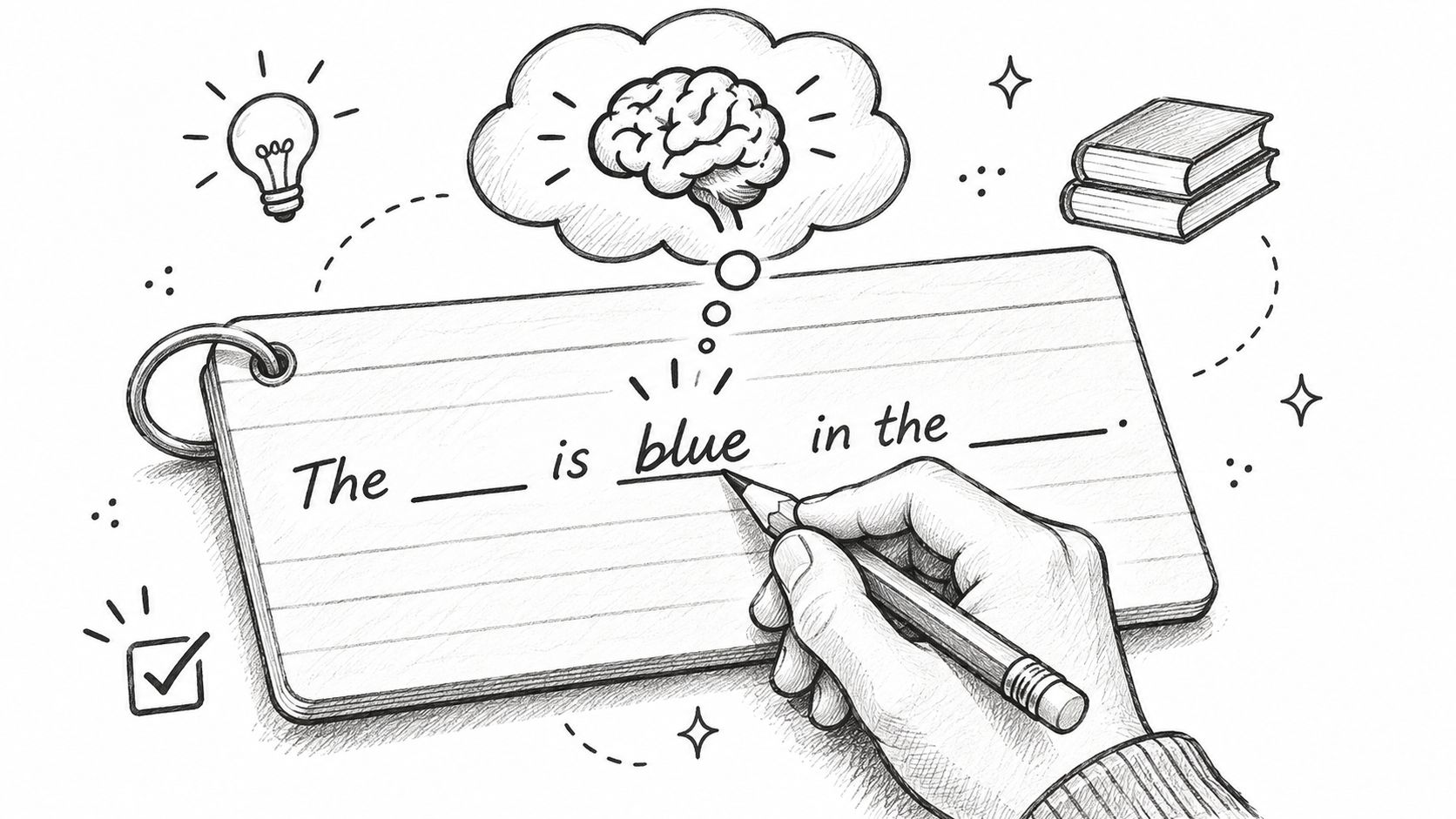
Take a highlight you care about and delete the part that carries the meaning. If the line reads "the constraint that shapes a decision is usually the deadline, not the information," you blank "deadline" and try to supply it. That's cloze deletion, and it's the most practical form of cued recall for readers working from saved passages.
The cue narrows the search, so the retrieval is easier than a blank page. That's the trade-off, and it cuts both ways. You can use cued recall on material too dense for free recall, on a second language, or on a book you're returning to after months. You also get less strengthening per attempt, because the cue does part of the work for you.
Getting the blanks right
People often blank too much and turn the exercise into guesswork. One or two key terms per sentence is enough. Blank the concept, not the prepositions.
- Vary the position. Blanks at the start, middle, and end of sentences stop you from learning a rhythm instead of the content.
- Reduce the cue as you improve. Hide the first letter only, then nothing at all. That's how a cloze turns back into free recall.
- Read the full sentence after answering. Context is part of what you're storing, and a term recalled without its surrounding claim is a term you'll misuse.
Cued recall earns its place when a passage has exact phrasing you want to keep, a definition you need word for word, or a distinction that collapses if you paraphrase it. For general understanding, the cue is scaffolding you should be removing, not a permanent home.
3. Practice Testing with Self-Generated Questions
Write the test yourself. After a chapter, draft five questions that require explanation, comparison, or application, then answer them from memory before you look at the text. Generating the questions is half the value, because deciding what's worth asking forces you to weigh the material.
The evidence on how far this carries is more specific than the usual advice suggests. A meta-analysis covering more than 40 years of retrieval-practice research found that testing produces transferable learning compared with rereading, with an overall effect of d = 0.40. That same analysis found transfer is weaker for rearranged stimulus-response items, for material that was never tested, and for some worked-example problems.
Question types that actually transfer
"What did the author say" tests recall of a sentence. It's the weakest question you can write, and it's the one most quiz tools give you.
- Application: "Where in my work would this apply next week?"
- Contradiction: "What would have to be true for this claim to fail?"
- Comparison: "How does this differ from the argument in the last book I read on the same topic?"
- Mechanism: "Why does this happen, in my own words, without the author's terminology?"
Feedback is the piece readers skip. Retrieval practice reliably fosters transfer when it's paired with correction, especially when you're applying knowledge or drawing inferences. Answering five questions and never checking them means you've rehearsed your errors. If you want a starting set of question stems, these reading prompts that force retrieval cover the application and counterexample angles.
Keep the count small. Five to ten questions per chapter is a session. Thirty is a project you'll abandon.
4. Flashcards (Question and Answer Cards)
A flashcard is a question on one side and an answer on the other, and the entire technique lives in the gap between them. You read the prompt, produce the answer from memory, then flip. If you flip early, you're rereading with extra steps.
For readers, the highest-value cards come from your own highlights. Front: the author's name and the idea in a phrase. Back: the passage. Or reverse it, front the passage and back the source, which is a harder and more useful card than it sounds, because attributing ideas correctly is most of what citing them requires.
Where flashcards fail
They're excellent for definitions, terms, names, dates, formulas, and exact quotations. They're poor for arguments, because a card can't hold the shape of a three-part case. Readers who convert an entire nonfiction book into cards usually end up with two hundred fragments and no thesis.
- One idea per card. Two facts on one card means you'll remember the easy one and fail the hard one without knowing which.
- Answer out loud or in writing before flipping. Silent recognition is not retrieval.
- Rate carefully. Marking a card easy when you half-guessed trains the schedule to show it less, which is the opposite of what you need.
- Retire mastered cards. After several clean recalls, pull the card and add new material. A deck that only grows stops being reviewed.
The honest test: if you can't say the answer before your thumb reaches the corner, you didn't know it.
5. Spaced Retrieval Practice (Spaced Repetition)
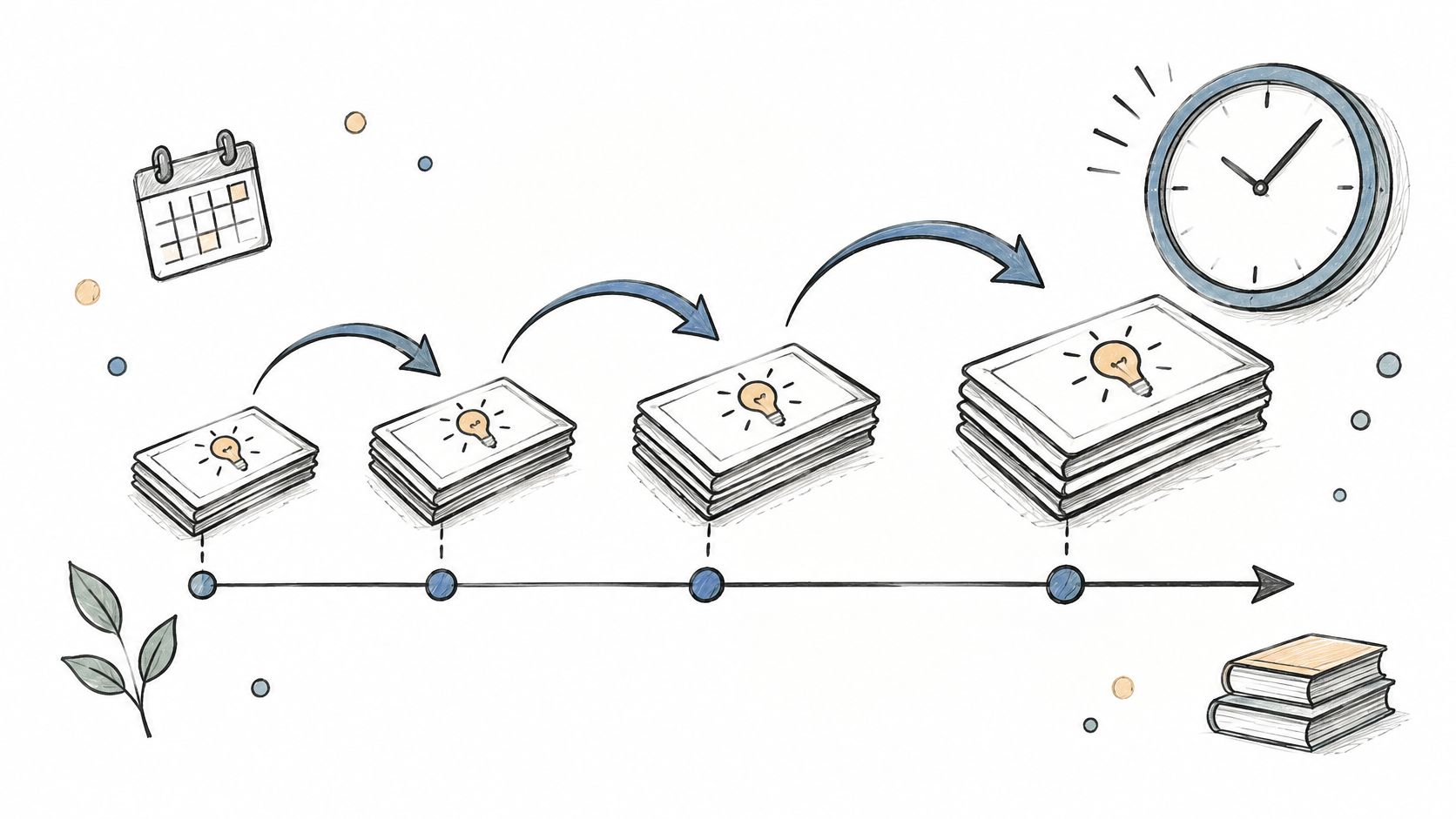
Spaced retrieval practice is active recall plus a schedule. You recall an item, see it again after a short delay, then after a longer one, and the interval grows each time you answer correctly. The point is to retrieve just as the memory is fading, which is more effortful and therefore more durable than reviewing something still fresh.
The scheduling benefit is well documented, though the size depends on the subject. A 2025 meta-analysis of mathematics learning found a small-to-medium benefit for spacing over massed practice, with g = 0.28 across 27 studies and 53 effect sizes, but found no conclusive consistent effect for retrieval practice itself, because the available evidence was smaller.
Read that carefully. Spacing works. Retrieval works. Stacking them doesn't guarantee a bigger effect than either alone, and the research base is thinner than productivity content admits.
Making the queue survivable
The failure mode is a backlog. Ten new highlights a day plus a growing review queue produces a pile you'll never clear, and an uncleared pile is worse than no system because it converts reading into debt.
- Cap the daily session. Five to ten items is enough to keep a library in circulation.
- Use reminders instead of willpower. A notification at a time you choose brings material back without a decision.
- Rate recall accurately so intervals stretch for what you know and tighten for what you don't.
- Add new passages slowly. Your library grows every time you read; your review capacity doesn't.
If you're applying this to a language exam, this guide to active recall for CELPIP prep covers the test-specific version. For the general mechanics of scheduling, how spaced repetition apps schedule reviews explains why intervals grow and where the algorithms differ. Quotabl's Daily Review works this way: highlights you keep returning on a growing schedule, and the ones you don't keep are shown less often.
6. Feynman Technique (Explain from Memory)
Pick a concept and explain it in plain language, out loud, as if the listener knows nothing about the subject. No notes, no jargon, no borrowed phrases from the author. Where you stall or reach for a vague word, you've found the edge of your understanding. Go back to the source, fill that specific gap, and explain it again.
This is the strongest technique for nonfiction that argues rather than informs. A book about decision-making can be summarized in a sentence and still not be understood. Explaining why the author's claim holds, and where it wouldn't, is a different task, and it exposes whether you've absorbed the reasoning or only the conclusion.
What to do with the stalls
- Mark every hesitation. A tick in the margin at each vague phrase gives you a map of what to reread.
- Ban the author's vocabulary on the first pass. If the explanation only works with the original terms, you're reciting.
- Explain it to an actual person when you can. A listener who interrupts with "why?" is a better feedback loop than a blank wall.
- Rewrite after filling gaps, then compare the two versions. The second should be shorter and more concrete.
Diagnostic: if your explanation needs the phrase "it's complicated," you've located the gap, not described it.
The cost is time. A Feynman pass on a difficult chapter takes fifteen minutes and feels slower than rereading it twice. That's the trade. You're buying understanding rather than coverage, and it's only worth it on material you intend to use.
7. Interleaved Retrieval Practice (Mixed-Topic Quizzing)
Interleaving means mixing material from different chapters, topics, or books in one session instead of working through them in blocks. You answer a question about habits, then one about negotiation, then one about attention, and your brain has to decide which framework applies before it can retrieve anything.
That decision is the point. Blocked practice lets you answer the third question about a topic because the first two primed the context. Mixed practice removes the context and forces you to discriminate between ideas that resemble each other. It feels worse. You'll get more wrong during the session and remember more afterwards.
Running a mixed session
- Start after a first pass. Interleaving material you've never understood is guessing, not retrieval.
- Shuffle before you start. Draw from three different books rather than working through one book's highlights in order.
- Hunt for the theme. When two passages from different authors argue the same point, that connection is worth more than either passage alone.
- Track your confusions. The pairs you mix up are the pairs to put in the same session repeatedly.
The practical version for readers is a weekly quiz drawn from three books on related subjects. A reading companion that surfaces recurring themes across your library does this without you building a deck, and it catches overlaps you wouldn't have thought to look for.
Interleaving is the technique most readers skip, because it's the one that makes them feel least competent. That's a poor reason to skip it and a very common one.
8. Recall Summaries (Write-from-Memory Recaps)
A recall summary is a structured recap written from memory, then checked against the source. It differs from a brain dump in one way that matters. A brain dump is unstructured output. A summary has a shape you committed to in advance, which forces you to decide what was central before you start writing.
Use a fixed frame every time. Main idea in one sentence, two supporting points, one application. Keeping it under 150 words is the discipline, because the word limit makes you choose.
The comparison step
Writing the summary is half the exercise. The other half is opening your saved passages and finding what you left out. A point you omitted wasn't central to your mental model, and that's either a correct judgment or a real gap. You can only tell which by looking.
- Mark additions in a second color so the gap between memory and source stays visible.
- Check your application line against the author's intent. Readers often summarize accurately and apply wrongly.
- Repeat the same frame after a week and after a month. Comparing three versions of the same summary shows you exactly what decayed.
- Keep the summaries. A folder of your own recaps is a far better review source than the highlights they came from, because they're written in your words.
This is the technique to reach for when you want to remember how a book's ideas connect rather than the ideas themselves. If retention across many books is the goal, this guide to how to remember what you read covers the wider system these techniques fit into.
Active recall techniques at a glance
Use this table to match a technique to the material you already have. The goal is not to build a separate study system from scratch. It is to turn book passages, highlights, and notes you already care about into prompts you can retrieve later.
| Technique | Cues provided | Best for | Time per session |
|---|---|---|---|
| Free Recall (Blank-Page Brain Dump) | No prompts; recall everything from memory | Checking how much of a book you retained | 3–5 minutes, or longer for a full summary |
| Cued Recall (Fill-in-the-Blank and Cloze Deletion) | Partial information, such as blanks or first-letter hints | Memorizing quotes, key terms, and specific facts | A short pass on selected highlights |
| Practice Testing with Self-Generated Questions | Questions you create about the material | Testing understanding beyond memorizing facts | Five to ten questions per chapter |
| Flashcards (Question and Answer Cards) | A question or prompt on one side; answer on the other | Memorizing key terms, names, and quotes | Short, flexible sessions |
| Spaced Retrieval Practice (Spaced Repetition) | Review prompts scheduled at increasing intervals | Retaining book highlights over the long term | Five to ten review items a day |
| Feynman Technique (Explain from Memory) | Explain the concept simply without notes | Understanding complex nonfiction ideas | About fifteen minutes on a difficult chapter |
| Interleaved Retrieval Practice (Mixed-Topic Quizzing) | Mixed questions from different topics or sources | Connecting ideas across books or subjects | A weekly quiz drawn from three books |
| Recall Summaries (Write-from-Memory Recaps) | A structured recap written from memory | Remembering and discussing a book's main ideas | A summary under 150 words |
The practical trade-off is effort versus coverage. Free recall is fast and exposes gaps, but it gives you little guidance. Cued recall and flashcards are tighter, so they suit exact wording and terms. Self-generated questions take longer to prepare, yet they test whether you can use an idea, not just recognize it.
Spacing changes the job. Questions and cards work well for early practice, while scheduled retrieval is better for keeping material alive after the chapter is no longer fresh. Quotabl fits that stage for readers using iPhone or Android: it syncs Kindle highlights and brings them back through a two-minute daily review, a Home Screen quote, and reminders. The reminder time and frequency are chosen by the user. Highlights the user keeps in Daily Review return on a growing schedule, and the ones they don't keep are shown less often.
Feynman, interleaving, and recall summaries cost more thought. Use them when complexity, cross-book connections, or discussion quality matter more than quick coverage.
Pick One Technique and Test It This Week
Eight techniques is too many to start. Pick one by support level rather than enthusiasm, because the right method depends on what you already have in your notes and highlights. If you cannot remember what a book argued at all, start with a blank-page brain dump. If you remember the argument but not the details, use cloze deletions on your saved passages. If you understand the parts and not the connections, write a structured recall summary.
Schedule one session this week, ten to fifteen minutes. Put it in your calendar with a time attached. A technique you intend to try is a technique you will keep postponing.
Use material from a book you finished recently, or from highlights you saved because they mattered. That choice matters more than the technique itself. Free recall on a book you read to impress someone will not survive a busy week. A passage you already marked, scanned or copied has a better chance, because it starts with your own attention.
Do the part many readers skip. When the session ends, open your saved highlights and compare them with what you produced. The distance between the two is your actual retention. That gap tells you what needs another pass, and rereading alone will not show it as clearly. Check your answers every time, since retrieval without correction rehearses mistakes as efficiently as it rehearses facts.
Keep the session short enough that you will repeat it. Five minutes every few days beats an elaborate flashcard system that collapses after a month. The techniques are interchangeable at the margin. The habit is not.
If you want reviews to happen without deciding each day, use the tools attached to the material you already keep. Quotabl's Daily Review presents a small selection of your saved highlights each day, and the ones you keep in rotation return on a growing schedule. The app collects Kindle highlights, scanned passages from printed books and manually entered quotes into one library, then brings them back through a two-minute daily review, a Home Screen quote and reminders at the time and frequency you choose. Visit Quotabl to import your first book and run a review session this week.

Written by
The Quotabl team
Makers of Quotabl
We make Quotabl, the app that syncs your Kindle highlights and brings them back with a daily review, a Home Screen widget and Margo, a reading companion. We write about reading, remembering what you read, and getting more out of your highlights.